Greggle · Ways of thinking · Objectives and Key Results
A way of thinking · best for a GoalObjectives and Key Results
One qualitative objective, a handful of numbers that would prove it, and the bets you are making to move them.
Andy Grove, Intel, 1970s
a Goal
An hour, then a quarter
A number, and an agreed place to read it
Where it came from
Peter Drucker proposed management by objectives in 1954: agree what each person is trying to achieve, then judge them on that rather than on how busy they look. Andy Grove, running Intel in the 1970s, found Drucker’s version too slow and too polite, and cut it down to two questions. Where do I want to go? That is the objective. How will I pace myself to see if I am getting there? Those are the key results. He described it in High Output Management in 1983.
John Doerr learned it as a young engineer at Intel, and in 1999 took it to a company of about forty people that had just taken his investment. Google has run on OKRs ever since. Doerr’s 2018 book Measure What Matters made the method famous, and made it fashionable enough that most companies now do it badly.
The version Greggle offers is Grove’s rather than the fashionable one: a single objective, two to five key results, each with a number and an agreed place to read it, and a review whose terms are set before the period starts.
Why it works
It separates the thing you want, which can be ambitious and even vague, from the numbers that would prove you got there, which can’t be. Most goals fail because they were only ever the first half. "Get properly good at guitar" is a wish until something says what good looks like in June and where the number will be read.
The discipline is entirely in the key results. Each is scored from outside: if you could claim it by pointing at effort, it is an activity, and it belongs under initiatives instead. Initiatives are bets on the numbers, not promises of work. If one finishes and no number moves, it was the wrong bet, and it gets dropped without ceremony.
When to reach for it, and when not to
Reach for it when you are aiming at something without a fixed end date and you want to know, in three months, whether you moved. A Goal, above all. It also suits a Project with a long horizon, where the milestones are too far apart to steer by.
It is the wrong tool for a decision or a diagnosis, and it is weak when the thing you want genuinely can’t be counted. Even then, try: there is usually a number hiding behind "done or not done". Greggle suggests it on a Goal, last of five, because the four before it help you know what the goal is.
How to run it
With a pen, on one sheet of paper.
- Write the objective in one sentence with no numbers in it, in words you would want to repeat. Say why this period rather than any other, and how long the period is. A quarter, usually.
- Write two to five key results. Each is an outcome in the world, not work performed: someone on holiday all period could still score it.
- Give each a number: where it stands today and where it lands. Then name the report, app or person everyone agrees to believe for that number. Settled now, or renegotiated at review time.
- Mark each result committed or a stretch. All committed promises nothing bold; all stretch promises nothing at all. If a result is done-or-not-done, say what number it would move and why you can’t measure that instead.
- List the initiatives, the work you believe will move the numbers. Each names the key result it is aimed at and roughly how far it should move it. Work aimed at everything is aimed at nothing.
- Set the review now: the date the numbers get read, what a seventy per cent period looks like, and who may drop an initiative mid-period when it isn’t moving its number.
There is a one-page card with these steps and a blank grid to fill in, made to print on A4. Or the PDF.
On a Greggle board
Pick Objectives and Key Results on a Goal board and Greggle proposes four steps: the objective, the key results with three to start, the initiatives with three to start, and the review. Apply it again to a sibling step for the next objective rather than stretching one to hold everything.
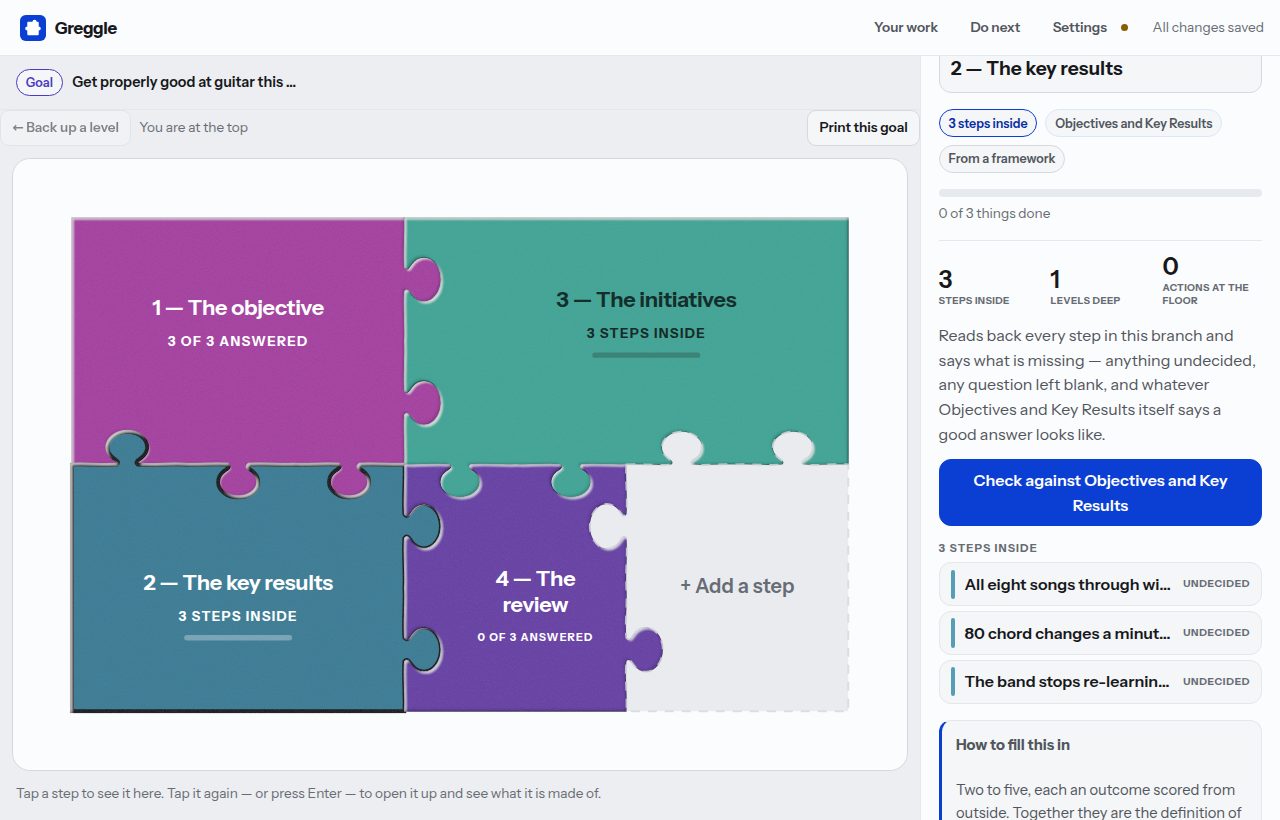
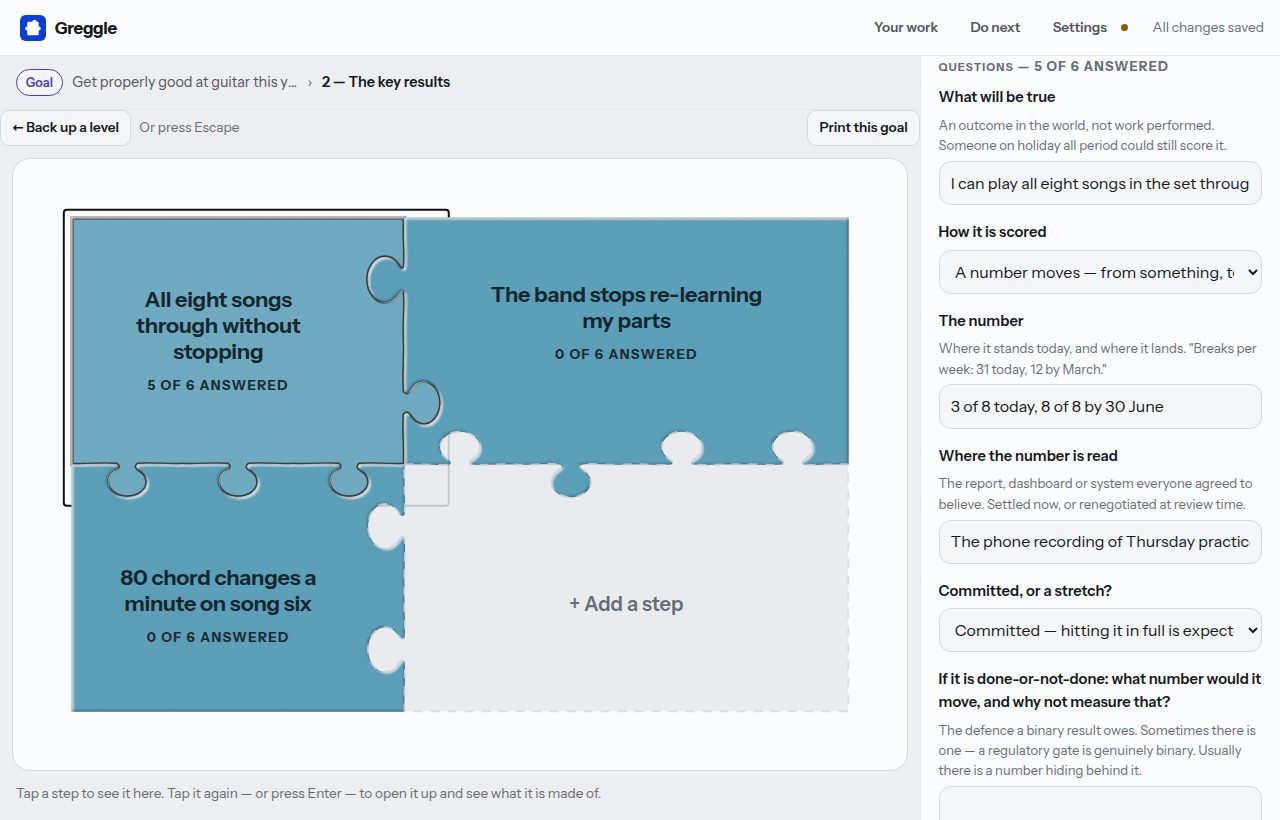
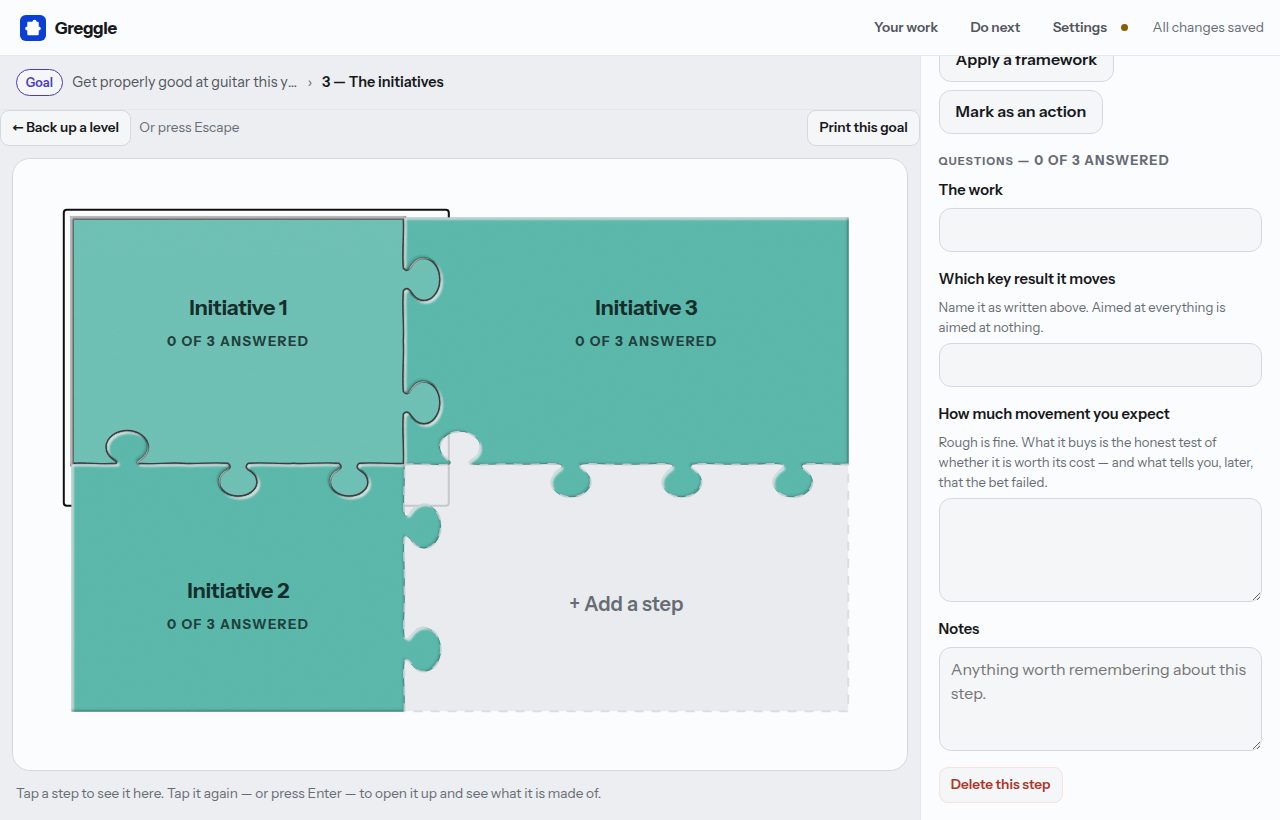
Nothing is added until you have looked at it. Open any step and it becomes a board of its own. Steps that cannot sensibly be cut smaller get marked as actions, and every action collects in one flat list.
What the check looks for
One button reads the whole branch back. On this method it reports, among other things:
- Key results have been written and not one has a number anywhere in it, so the period ends in adjectives.
- A result is done-or-not-done with no defence of why it can’t be a number.
- Nothing says where its number is read, so it will be renegotiated at review time by whoever the number embarrasses least.
- Initiatives have been listed and the results they are supposed to move have not, which is a to-do list with a slogan on top.
A worked example
The first draft of result 3 was "the band trusts me", which nobody could score. Finding the number behind it took five minutes and turned a feeling into something the recording can answer.
Where it falls down
Companies pile OKRs up until nobody reads them, then score them all green at the end of the period by arguing about what the words meant. One objective at a time is plenty for a person, and the agreed place to read each number is the defence against the argument.
The other failure is confusing initiatives with results. "Practise every day" is work, and doing it proves nothing about whether you got better. It belongs as a bet, aimed at a number, and if the number doesn’t move the bet was wrong however faithfully it was kept.
Pairs well with
- Working Backwards. When the goal has an end date, walk back from it instead. The evidence list there is a set of key results.
- Pre-mortem. Greggle suggests it first on a Goal. Imagine the period failed, then set the key results that would have caught it.
- Theory of Constraints. If the numbers won’t move whatever you do, the constraint is somewhere the initiatives aren’t.
Further reading
- Andrew S. Grove, High Output Management, 1983. The OKR chapter is short and better than anything written about it since.
- John Doerr, Measure What Matters, 2018, for the Google story and the case studies.
- Peter F. Drucker, The Practice of Management, 1954, where management by objectives begins.
Say what you want. Then say what would prove it.
This opens the app with the kind already chosen. Give the thing a name, press Start, and Objectives and Key Results is proposed on the new board for you to look over before anything is added. Free, no account, works offline.
Open Greggle with Objectives and Key Results