Greggle · Ways of thinking · Pre-mortem
A way of thinking · best for a Project or a RiskPre-mortem
It is twelve months from now and this failed. Work out why, then prevent it.
Gary Klein, 2007
a Project or a Risk, before it starts
Twenty minutes
Everyone who will do the work
Where it came from
Gary Klein is a psychologist who spent his career studying how firefighters, nurses and soldiers make decisions under pressure, and he noticed that once a plan existed, the people on it stopped looking for its flaws. He published the pre-mortem in Harvard Business Review in September 2007 as a short, almost trivially simple fix. Tell the team the plan has failed, and ask them why.
It rests on a 1989 experiment by Deborah Mitchell, Jay Russo and Nancy Pennington. They asked people to explain a future event. Some were told it might happen; others were told it had happened, and to explain it in hindsight. The second group came up with about thirty per cent more reasons, and more specific ones. They called it prospective hindsight. Certainty, even pretend certainty, unlocks reasons that possibility doesn’t.
Daniel Kahneman gave the pre-mortem a page of Thinking, Fast and Slow and has recommended it as his preferred check on overconfidence. It costs almost nothing, which is why it is worth running on almost everything.
Why it works
Doubt feels disloyal. Once a group has agreed a plan, pointing out how it might fail sounds like an accusation against whoever proposed it, so people don’t. The pre-mortem makes the failure a premise instead of a prediction. You aren’t saying it might fail. You have been told it did, and your job is to be the person who explains why. Everyone gets permission to be the pessimist at once.
The past tense matters. "We ran out of money" comes out of a different part of the head than "we might run out of money". So does the silent writing: if the room talks, the first confident voice sets the list and everyone else adds variations. If everyone writes alone first, you get the quiet person’s reason, which is often the one nobody else saw.
When to reach for it, and when not to
Reach for it when a plan exists and hasn’t started. That is the window. Run it too early and there is nothing to break; run it once the work is under way and it turns into a list of excuses for what is already going wrong.
It is also useful on a decision you have nearly made. Tell yourself you chose the thing and it went badly, and see what comes to mind. If nothing does, that is worth knowing too. Greggle suggests it first on a Goal, a Project and a Risk, and on a Decision and an Opportunity as well: five of the seven kinds.
How to run it
With a pen, on one sheet of paper.
- State what you are about to commit to, in a few lines, and when you would know whether it had worked.
- Announce it. "It is a year from today. This went badly. Not slightly, badly." Say it as a fact.
- Everyone writes, alone and in silence, every cause they can think of, in the past tense. Two minutes. Nobody talks.
- Go round the room. Each person reads one cause. Keep going round until the lists are empty. No discussion yet, and no defending the plan.
- Judge each cause against the others: how likely is it really, and how bad would it be? Fatal means the whole thing fails. Serious means a major delay or cost. Annoying means you’d recover.
- For each cause worth acting on, write something you could start this month, and say whether you are preventing it, reducing it, or accepting it. An accepted risk gets its reason written beside it.
There is a one-page card with these steps and a blank grid to fill in, made to print on A4. Or the PDF.
On a Greggle board
Pick Pre-mortem on a Project board and Greggle asks what you are committing to and when you would know, then proposes two steps: why it failed, with four causes to start, and what to do about it now, with three actions to start. Both take up to twelve.
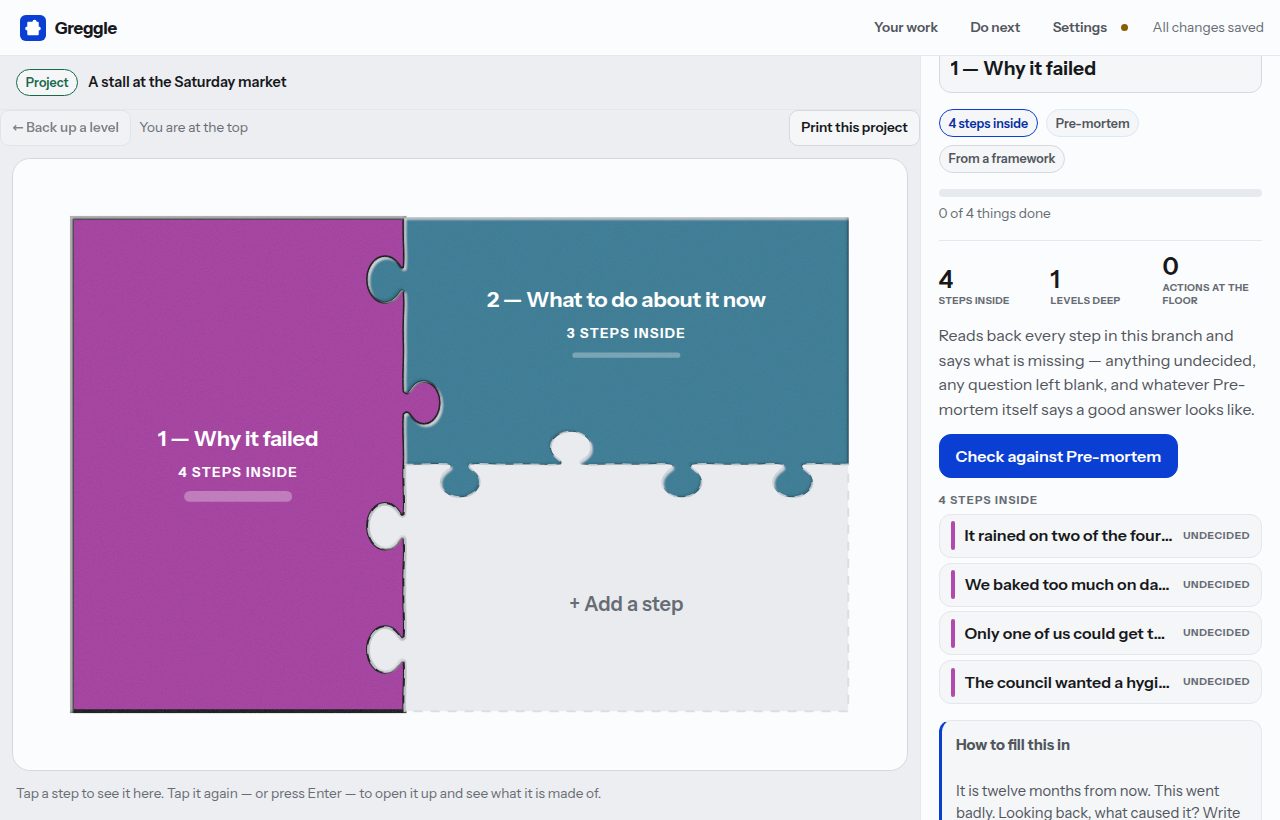
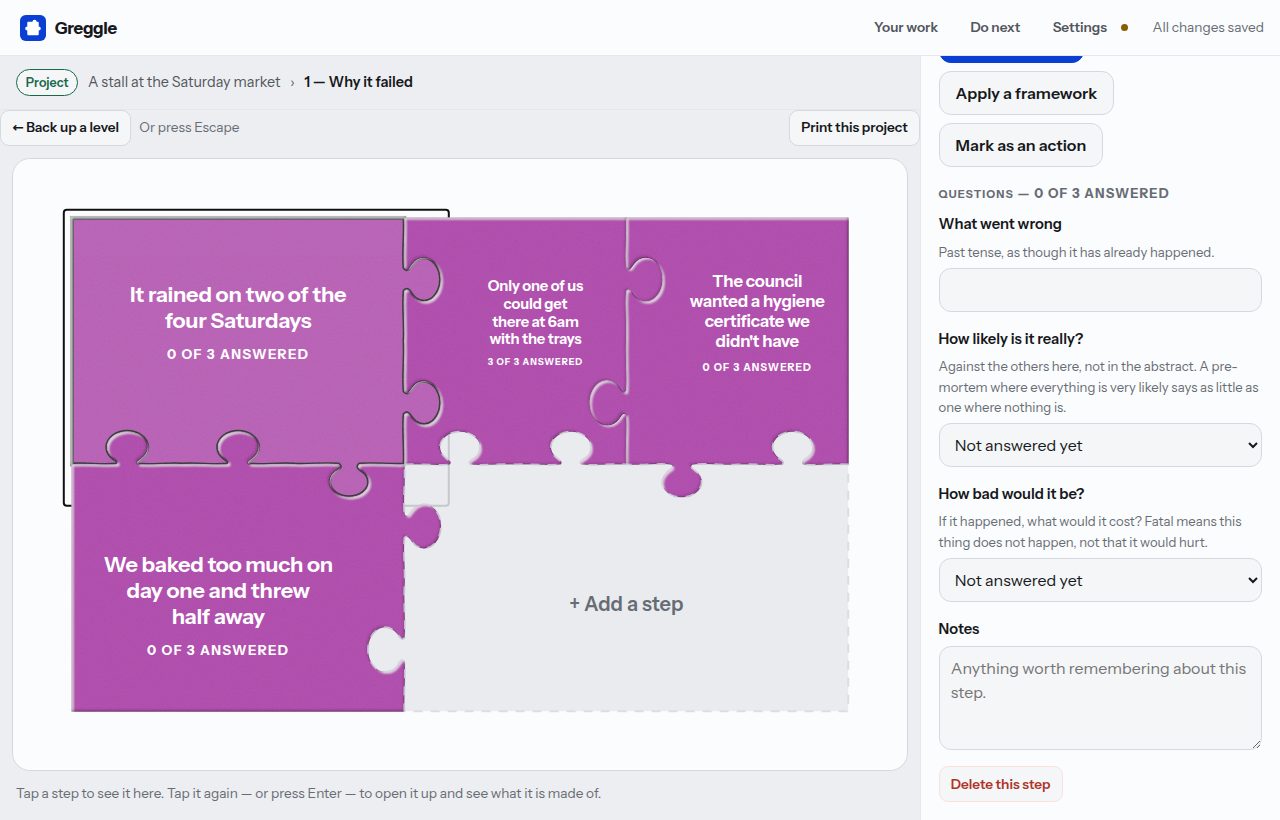
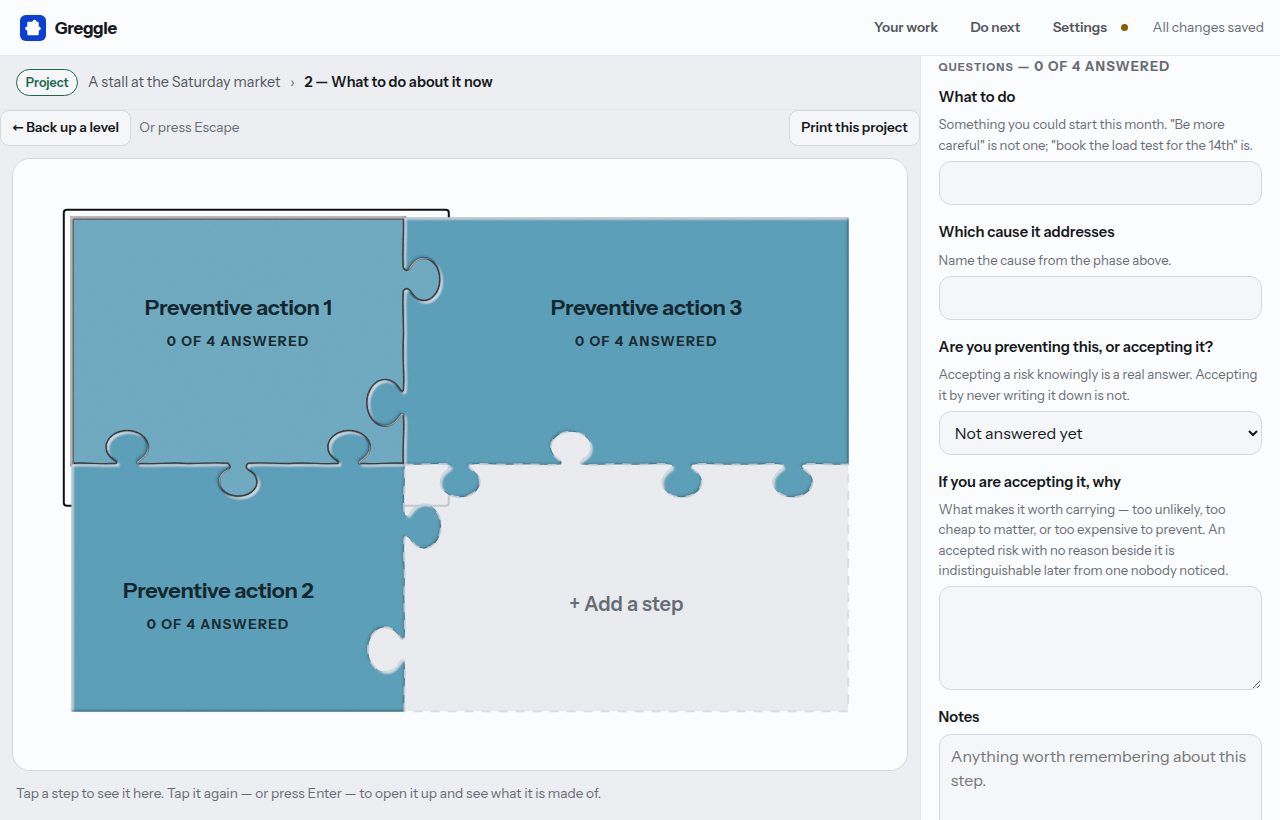
Nothing is added until you have looked at it. Open any step and it becomes a board of its own. Steps that cannot sensibly be cut smaller get marked as actions, and every action collects in one flat list.
What the check looks for
One button reads the whole branch back. On this method it reports, among other things:
- The failure has been imagined and nothing has been written under what to do about it.
- None of the causes would actually sink this. The awkward cause is the one that got left out.
- All the causes carry the same likelihood, which is a form filled in rather than a judgement made.
- A cause is accepted and does not say why. A month from now it will look identical to one nobody noticed.
A worked example
The plan. Rent a stall for four Saturdays in November selling the baked things that sell well at school. Split the profit three ways. We would know by the end of November: did it cover the stall fees, and are we still friends.
The news. It is next spring. The stall lost money and two of the three of you aren’t speaking.
Notice that the reason most likely to end friendships was the one about sharing, and it took a pretend failure to say it out loud. Notice too that accepting the rain, with the reason written down, is a real answer. Never mentioning it is not.
Where it falls down
Done as a discussion instead of silent writing first, the loudest voice sets the list. Done by one person alone, it still works, but you only get one person’s blind spots. Done too late, it becomes a post-mortem with extra steps.
The other failure is stopping after the list. A pre-mortem that produces twelve causes and no changes to the plan was a nice conversation. The value is entirely in the actions at the end, each one naming the cause it answers, and in the honest decision to accept the causes you can’t prevent, with the reason written down.
Pairs well with
- Working Backwards. Write the ending first, plan back to now, then run a pre-mortem on the plan. One walk forward and one back.
- Scenario Planning. When the causes of failure are outside your control, the weather or the council, build the futures instead of trying to prevent them.
- 5 Whys. A cause that surprises you deserves five whys of its own.
Further reading
- Gary Klein, "Performing a Project Premortem", Harvard Business Review, September 2007. Two pages.
- Deborah J. Mitchell, J. Edward Russo and Nancy Pennington, "Back to the future: Temporal perspective in the explanation of events", Journal of Behavioral Decision Making, 1989.
- Daniel Kahneman, Thinking, Fast and Slow, 2011, chapter 24.
Tell yourself it failed. Then find out why.
This opens the app with the kind already chosen. Give the thing a name, press Start, and Pre-mortem is proposed on the new board for you to look over before anything is added. Free, no account, works offline.
Open Greggle with Pre-mortem