Greggle · Ways of thinking · Scenario Planning
A way of thinking · best for a Challenge or an OpportunityScenario Planning
Pick the two uncertainties that matter most and are genuinely independent, build the four worlds they produce, then plant the signposts that tell you which one you are entering.
Herman Kahn, RAND, 1950s; Pierre Wack, Shell, 1970s
a Challenge, an Opportunity, a Decision
Two hours, then a date to revisit
A decision, a horizon, and honesty about what is already settled
Where it came from
Herman Kahn at the RAND Corporation in the 1950s, thinking through nuclear futures nobody wanted to imagine, gave the method its name and its reputation for saying the unsayable. Pierre Wack, running a small planning team at Shell in the early 1970s, gave it its purpose. Wack’s team built scenarios in which the oil-producing countries organised, cut supply and pushed the price up several times over. When the embargo came in October 1973 and did exactly that, Shell’s managers had already thought it through, and the company came out of the decade stronger than any rival.
Wack was clear that the point was not to predict. It was to change what the managers could imagine, so that when the world moved they recognised it. He wrote two articles for Harvard Business Review in 1985 that are still the best account. Peter Schwartz, who succeeded him at Shell, turned the method into a book, The Art of the Long View, in 1991.
The two-axes grid, four worlds from the two most decisive uncertainties, is the version Schwartz taught and the version Greggle uses.
Why it works
Forecasting picks one future and bets on it. Scenarios pick the two most uncertain and most decisive forces, cross them, and give you four futures to rehearse. You stop asking "what will happen" and start asking "what would I do if", which is a question you can actually answer now.
Two things make it work rather than just interesting. The axes have to be independent: if knowing how one lands tells you how the other does, the four worlds are really two, and the grid is decoration. And the signposts have to be planted: early, observable signs that one world is arriving rather than another. A scenario nobody can check against reality is a story.
When to reach for it, and when not to
Reach for it when the right answer depends on things outside your control that could genuinely go either way within the time you care about. A Challenge whose outcome depends on how the world turns, an Opportunity whose value does, a Decision with a long horizon.
It is the wrong tool for a decision whose uncertainties are all inside your control; that is Options and Criteria or Force Field Analysis. And it is wasted on a horizon so short that nothing can diverge, or so long that the decision no longer exists. Greggle suggests it on a Challenge and an Opportunity.
How to run it
With a pen, on one sheet of paper.
- Name the decision the scenarios are for, the horizon, and what is effectively settled between now and then. The settled things hold in every world; they are the walls of the grid, not its axes.
- List the uncertainties: things that could genuinely land either way, with both ends named. Weigh each against the others: decisive, shapes the decision, or background.
- Promote exactly two to axes: the most decisive pair that are independent of each other. Ask the question out loud: would knowing how one lands tell you how the other does? If yes, keep the more decisive and find another.
- Cross the axes. Each corner is a world. Name each one, say which end of each axis it takes, and write the plausible route from today to it. All four get equal effort, including the one you find implausible.
- For each world, list what it makes true that isn’t true today, and what you would do about it: now, or prepared now and done then.
- Plant signposts: early, observable signs that a world is arriving, each tied to a world by name and to a place you actually look. Then write the moves that are right in every world, the bets that back one world, and the date you will read the signposts next.
There is a one-page card with these steps and a blank grid to fill in, made to print on A4. Or the PDF.
On a Greggle board
Pick Scenario Planning on a Challenge or Opportunity board and Greggle proposes five steps: the decision and horizon, the uncertainties with three to start, four worlds each with two implications to start, the signposts, and what you would do now.
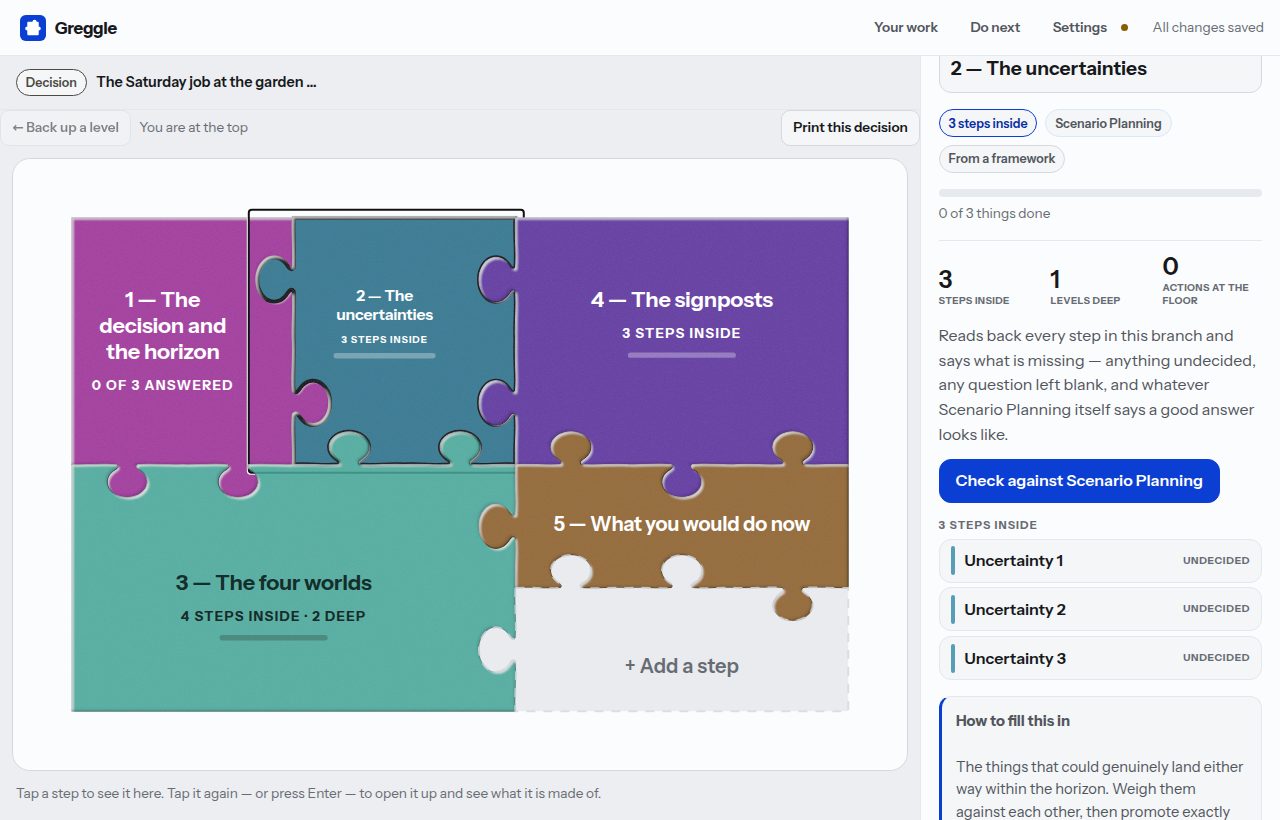
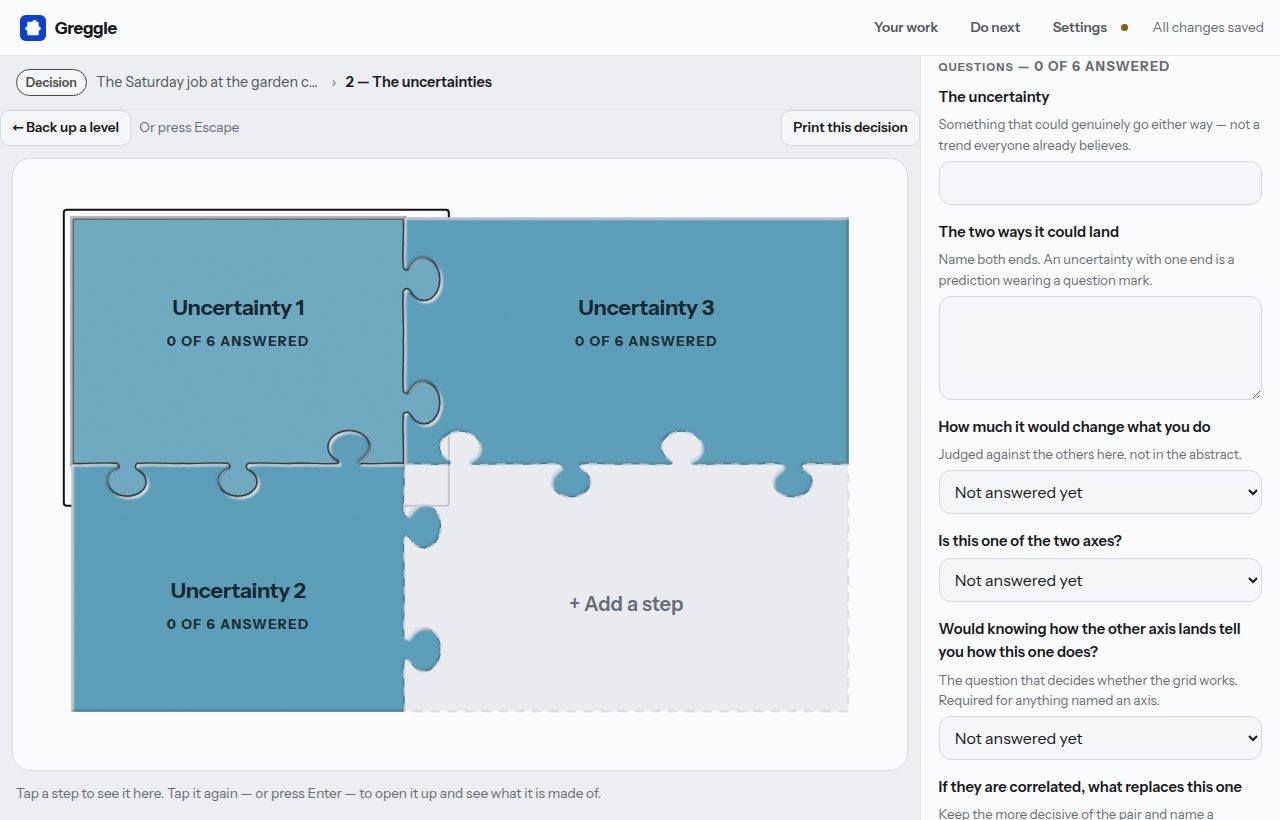
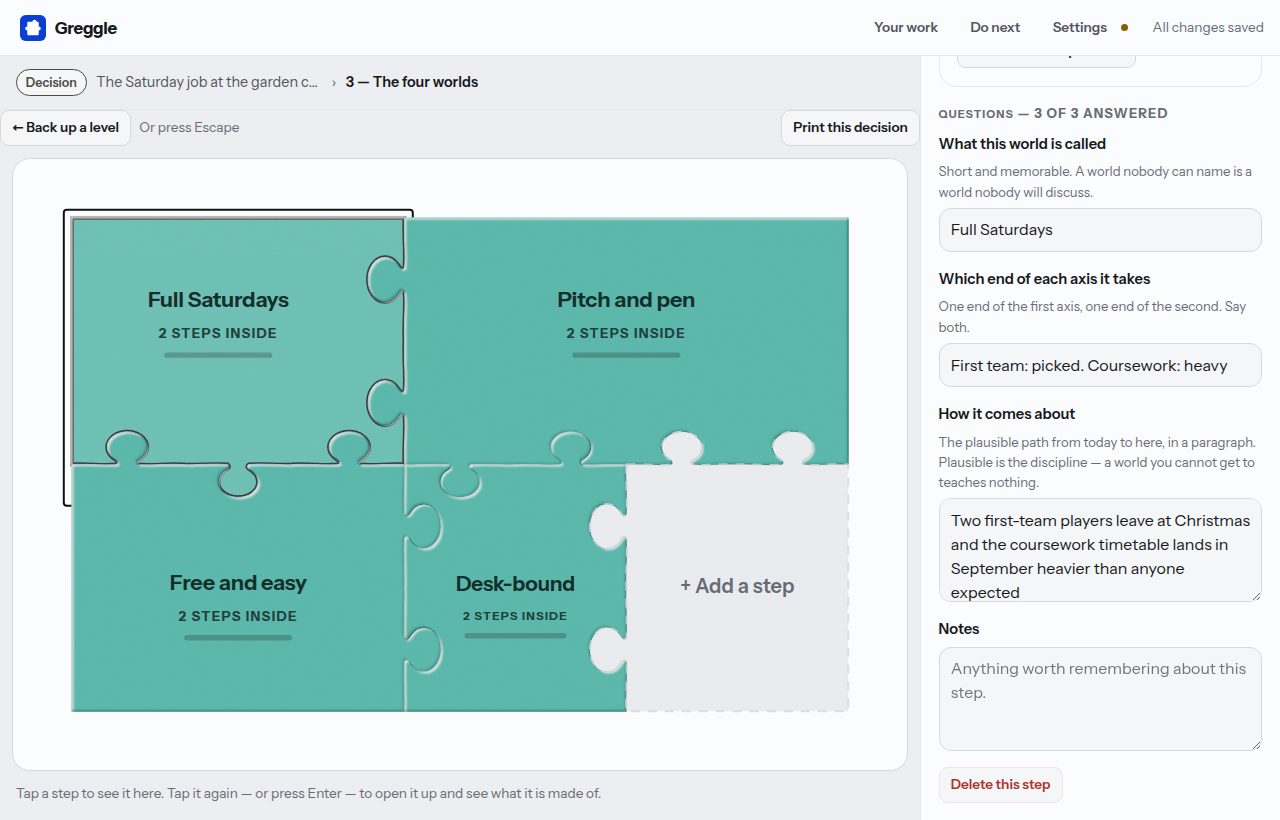
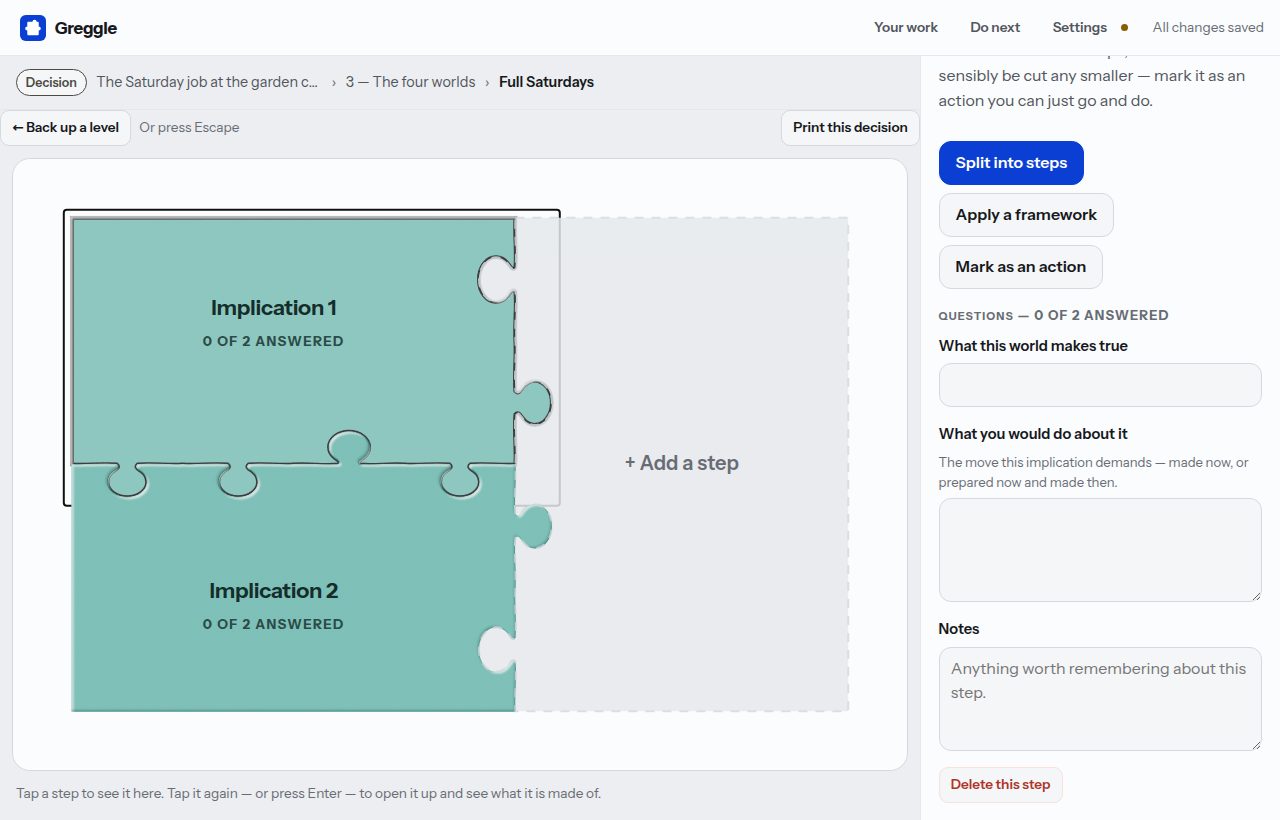
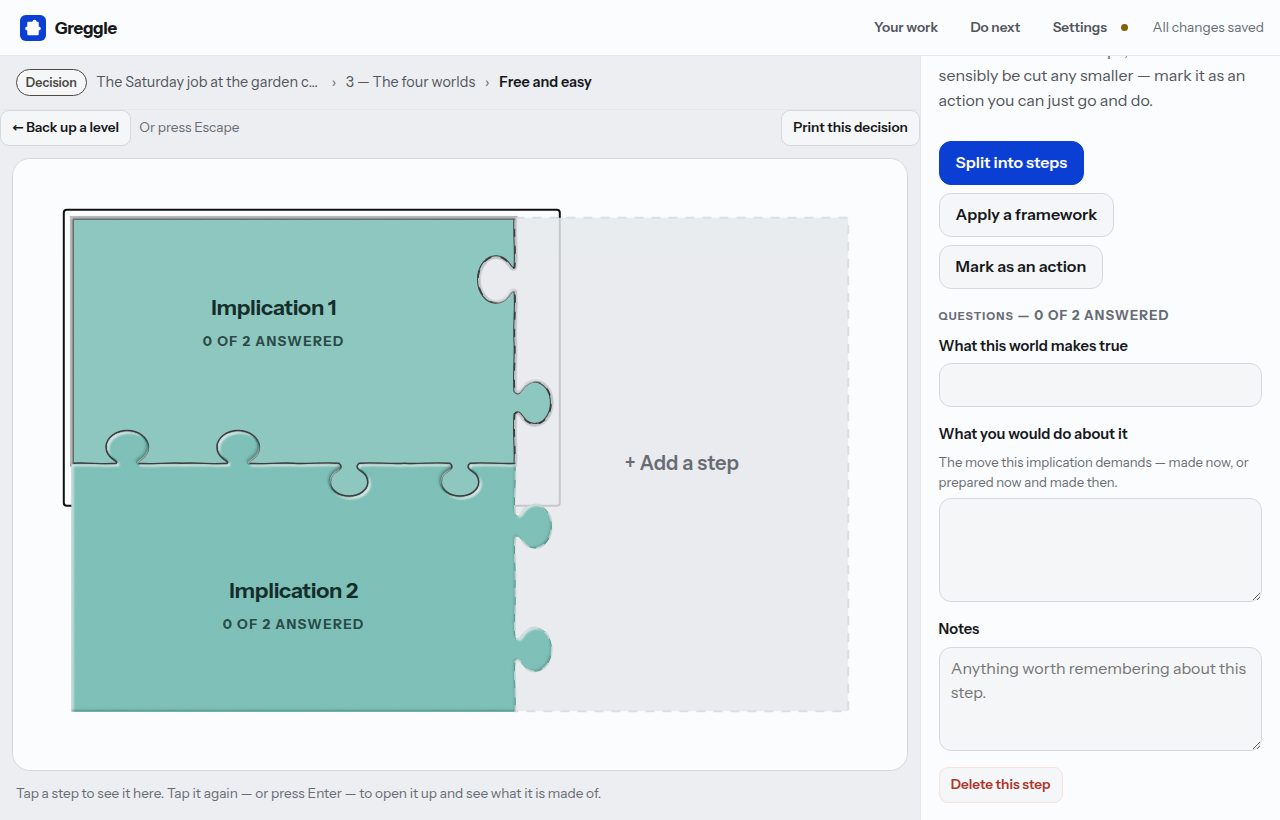
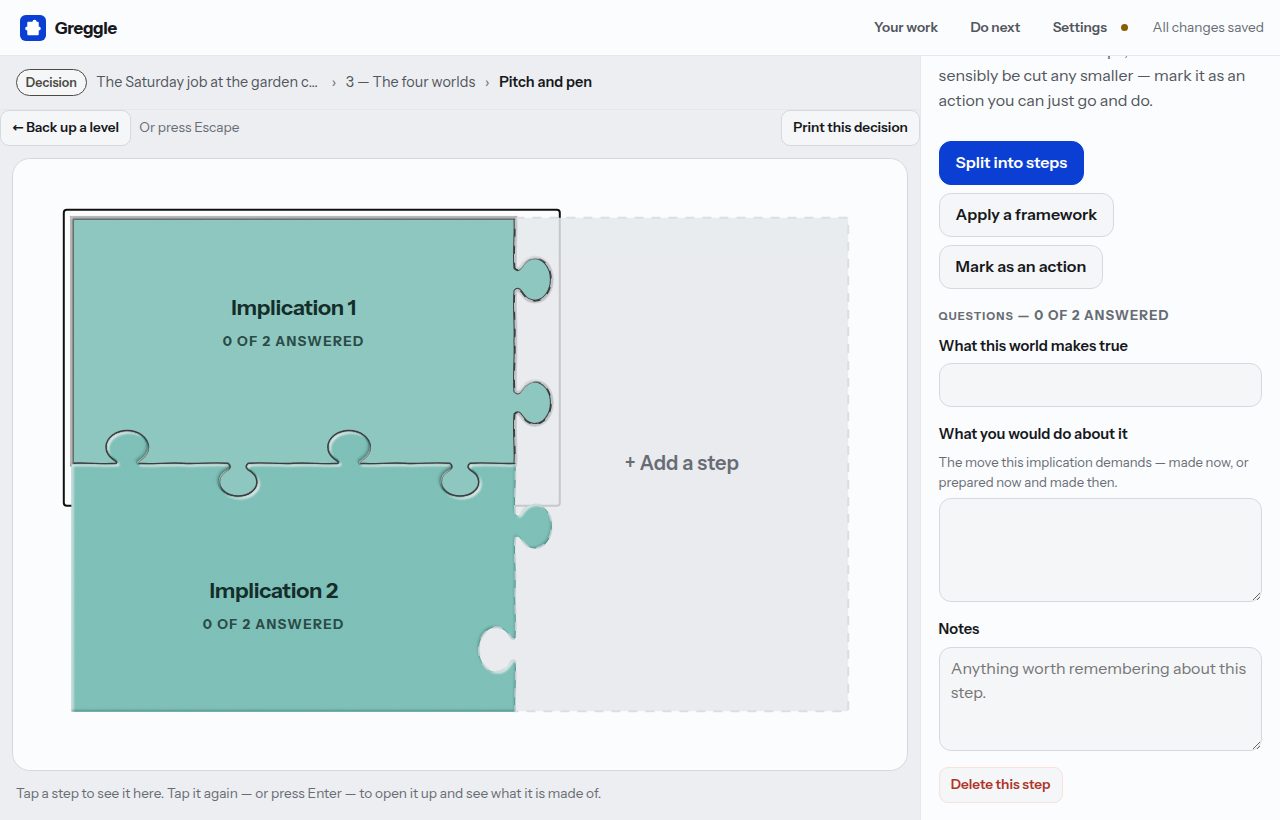
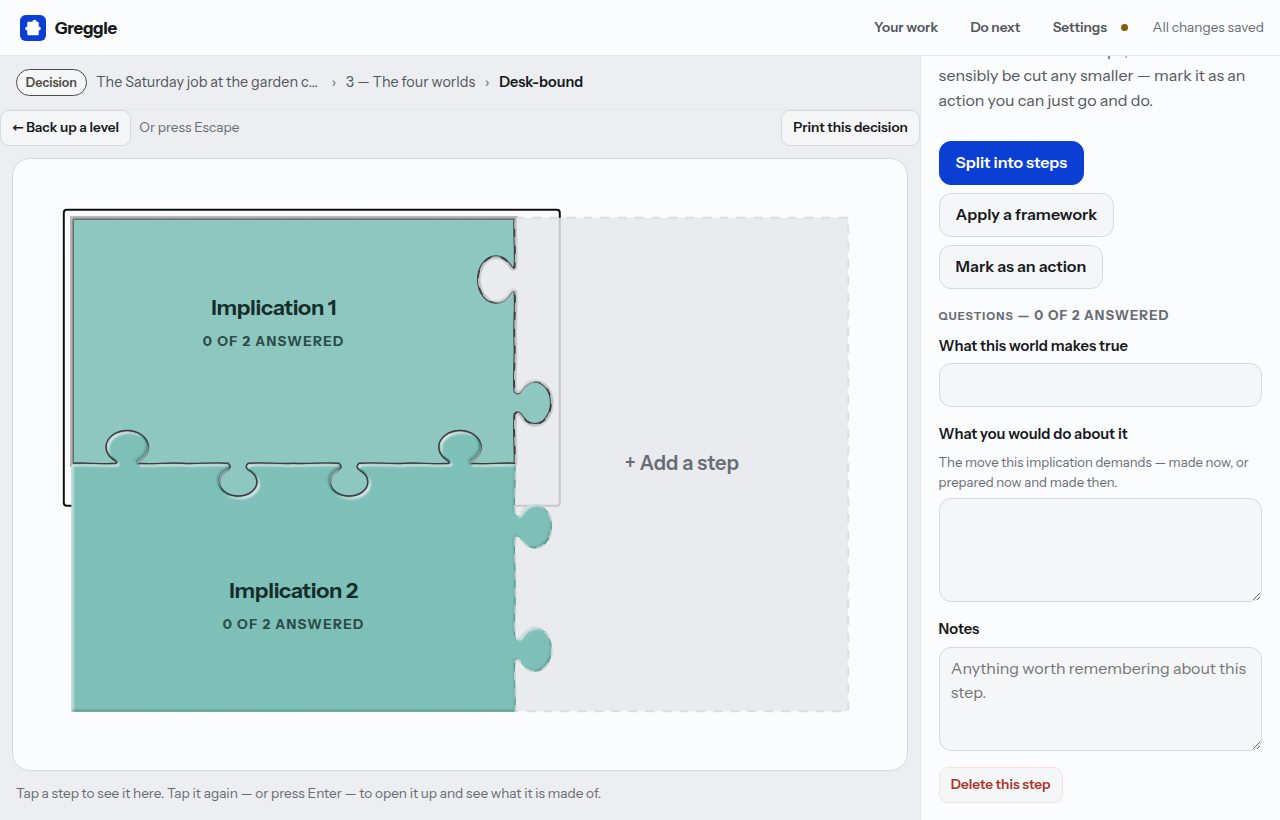
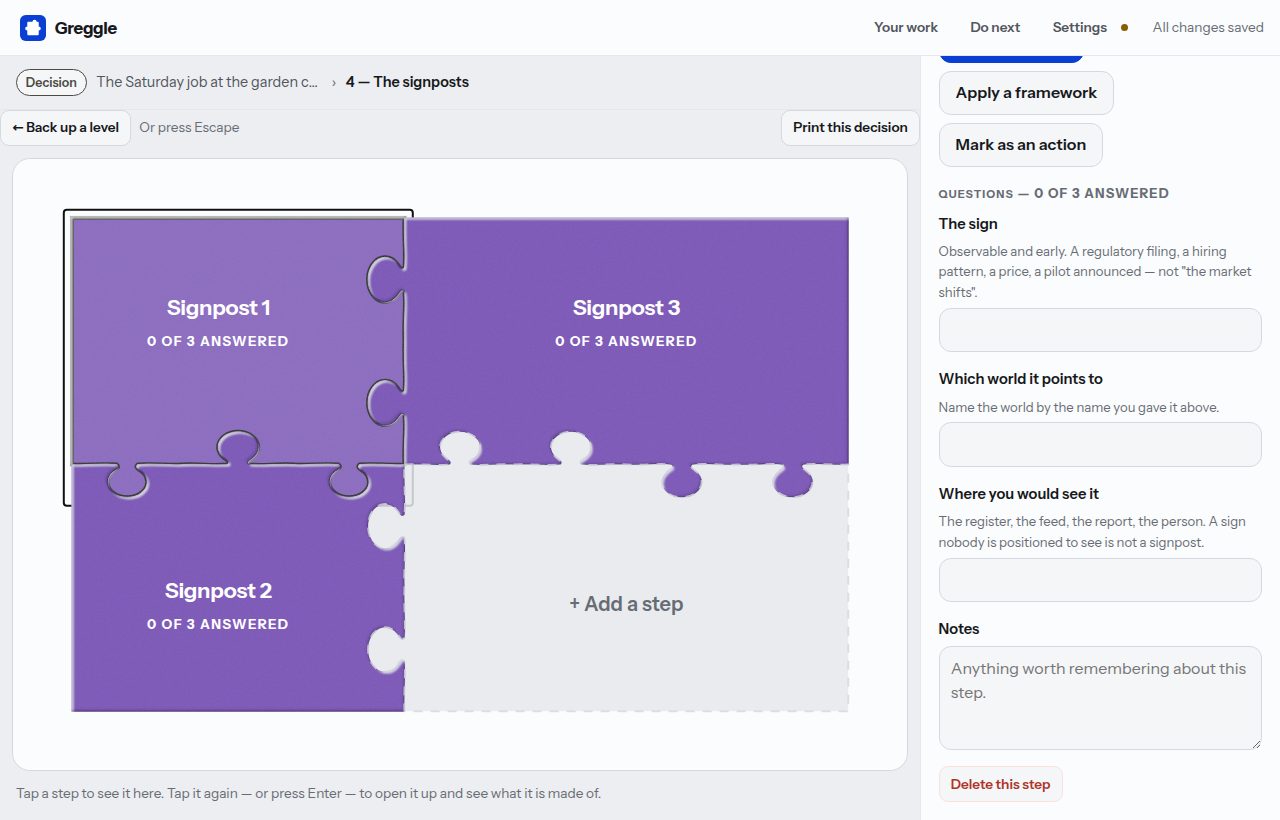
Nothing is added until you have looked at it. Open any step and it becomes a board of its own. Steps that cannot sensibly be cut smaller get marked as actions, and every action collects in one flat list.
What the check looks for
One button reads the whole branch back. On this method it reports, among other things:
- Three or more uncertainties are each named as an axis. A grid has two.
- An axis has never been checked for independence from the other, or admits it is correlated and nothing replaces it.
- Worlds have been named and not one has a plausible route from today.
- Nothing has been written under the signposts, which is what separates scenario planning from science fiction.
A worked example
The move that survives every world, asking about Sundays, is the cheapest output of the exercise and the one nobody would have thought of without building the corner they didn’t expect.
Where it falls down
Four futures becomes fourteen becomes none. Two axes, four boxes, that’s the method, and the box you find implausible gets the same effort as the rest, because it is the one that teaches you most when it starts arriving anyway.
The other failure is scenarios that are never revisited. Without signposts and a date to read them, the four worlds become the office mural: admired, referred to, never checked. Wack’s point was that the scenarios change what you can recognise, and you only recognise what you keep looking for.
Pairs well with
- Pre-mortem. When the causes of failure are outside your control, build the worlds instead of trying to prevent them.
- Options and Criteria. Judge the options in each world, not just one. An option that wins in three of four is a different thing from one that wins in one.
- Stakeholder and Influence Map. The signposts are often people. Who would know first that a world is arriving?
Further reading
- Pierre Wack, "Scenarios: Uncharted Waters Ahead" and "Scenarios: Shooting the Rapids", Harvard Business Review, September and November 1985.
- Peter Schwartz, The Art of the Long View, 1991. The two-axes method, step by step.
- Herman Kahn and Anthony Wiener, The Year 2000, 1967, for where the word came from.
Build four futures. Then plant the signposts.
This opens the app with the kind already chosen. Give the thing a name, press Start, and Scenario Planning is proposed on the new board for you to look over before anything is added. Free, no account, works offline.
Open Greggle with Scenario Planning