Greggle · Ways of thinking · Stakeholder and Influence Map
A way of thinking · best for a Project, a Challenge or an OpportunityStakeholder and Influence Map
Who decides, who can block it, what each of them actually wants, and what it would take to move them.
Freeman, 1984; Mendelow, 1981
a Project, a Challenge, an Opportunity
Half an hour
Candour, and a name beside every blocker
Where it came from
The word came into management through R. Edward Freeman’s 1984 book Strategic Management: A Stakeholder Approach, which argued that a company answers to everyone who can affect it or is affected by it, not only to its owners. The picture came from Aubrey Mendelow, who in 1981 proposed placing each person on a grid of power against interest: who can affect this, and how much do they care. Keep the powerful and interested close, keep the powerful and uninterested satisfied, keep the rest informed.
Greggle’s version keeps Mendelow’s two axes but asks a sharper pair of questions. Not power in general but influence on this decision specifically. Not interest but where they stand today, from champion to opposed, honestly. And it insists on one thing the classic grid leaves out: the name of the person who is going to talk to each of them.
Why it works
Most things that fail with people fail because someone who could block it was never asked, or someone who cared was treated as if they didn’t. Putting names on a grid makes those gaps visible before they cost you.
Influence and position are different questions, and keeping them separate is the whole point. Someone can be strongly supportive and unable to help you at all. Someone else can be neutral and hold the only yes that counts. And the person people actually listen to is frequently not the person above them, which is why the map asks who has each person’s ear.
When to reach for it, and when not to
Reach for it when the outcome isn’t yours to control and depends on other people agreeing, or at least not objecting. A Challenge where someone has to say yes, an Opportunity that needs permission, a Project with more than two people in it.
It is the wrong tool for a decision that is only yours, and it is dangerous when it isn’t candid. A map of what people said in the meeting is a map of the room you were hoping for. Greggle suggests it on a Project, a Challenge and an Opportunity.
How to run it
With a pen, on one sheet of paper.
- Write what has to be decided, precisely. "Approve the hall for Thursdays after five", not "get everyone on board". Name who formally decides, and by when, and what happens if it slips.
- List everyone with a say or a stake, one line each. Include the people who can’t help you but can stop you, and the ones with no formal role who are listened to anyway.
- For each, say what part they play: decides, advises, implements, affected, or gatekeeper. Then what they actually want, which is often about something else entirely.
- Rate each person’s influence on this decision specifically: high, medium or low. Then where they stand today, honestly: champion, supportive, neutral, sceptical or opposed. Somebody is opposed. If nobody is, look again.
- For each, write what would move them: the evidence, the concession or the reassurance. "Nothing" is a real answer and changes the plan. Note who has their ear.
- Put a name and a week beside everyone you need to move, opposed and sceptical first. Then decide the order of conversations, the one to have this week, and what you do if the key person says no.
There is a one-page card with these steps and a blank grid to fill in, made to print on A4. Or the PDF.
On a Greggle board
Pick Stakeholder and Influence Map on a Project, Challenge or Opportunity board and Greggle proposes the decision, the people with four to start, and the approach. Each person is a step with eight questions.
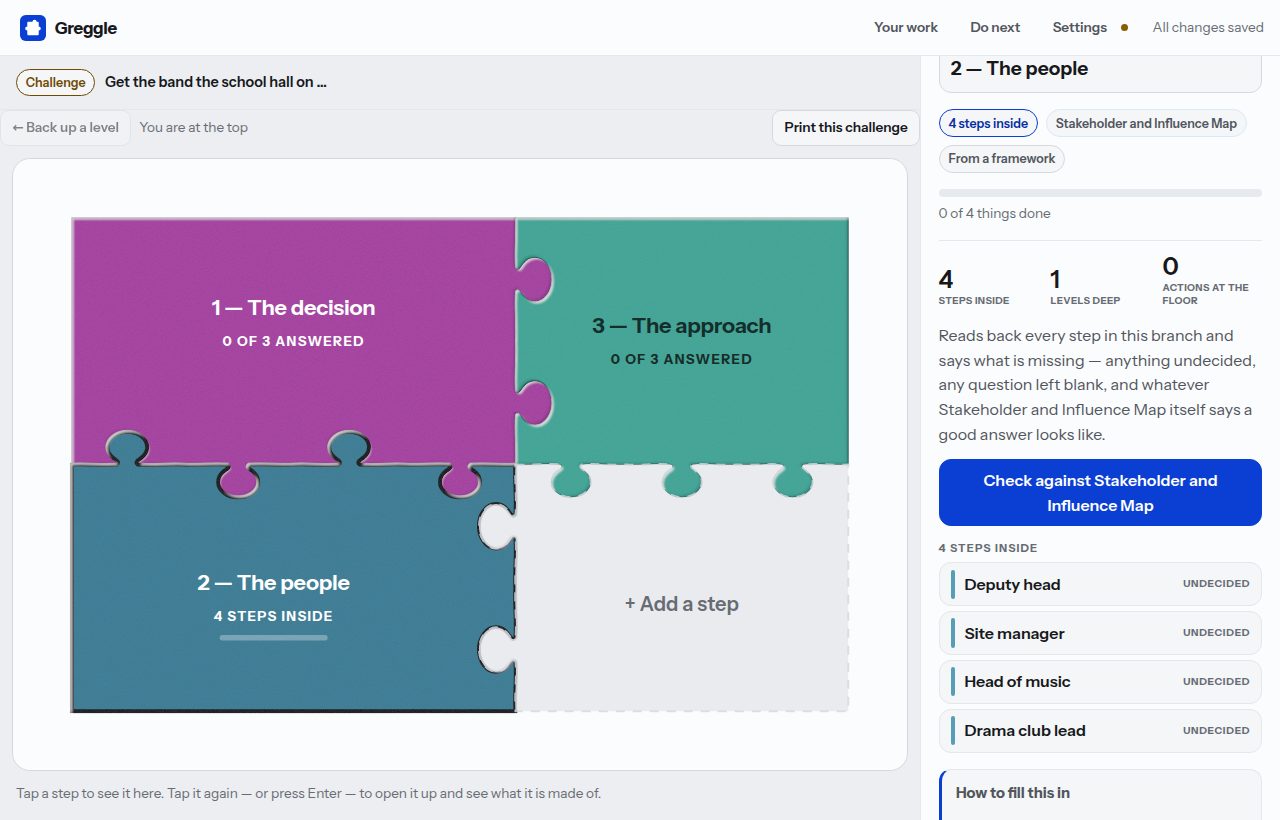
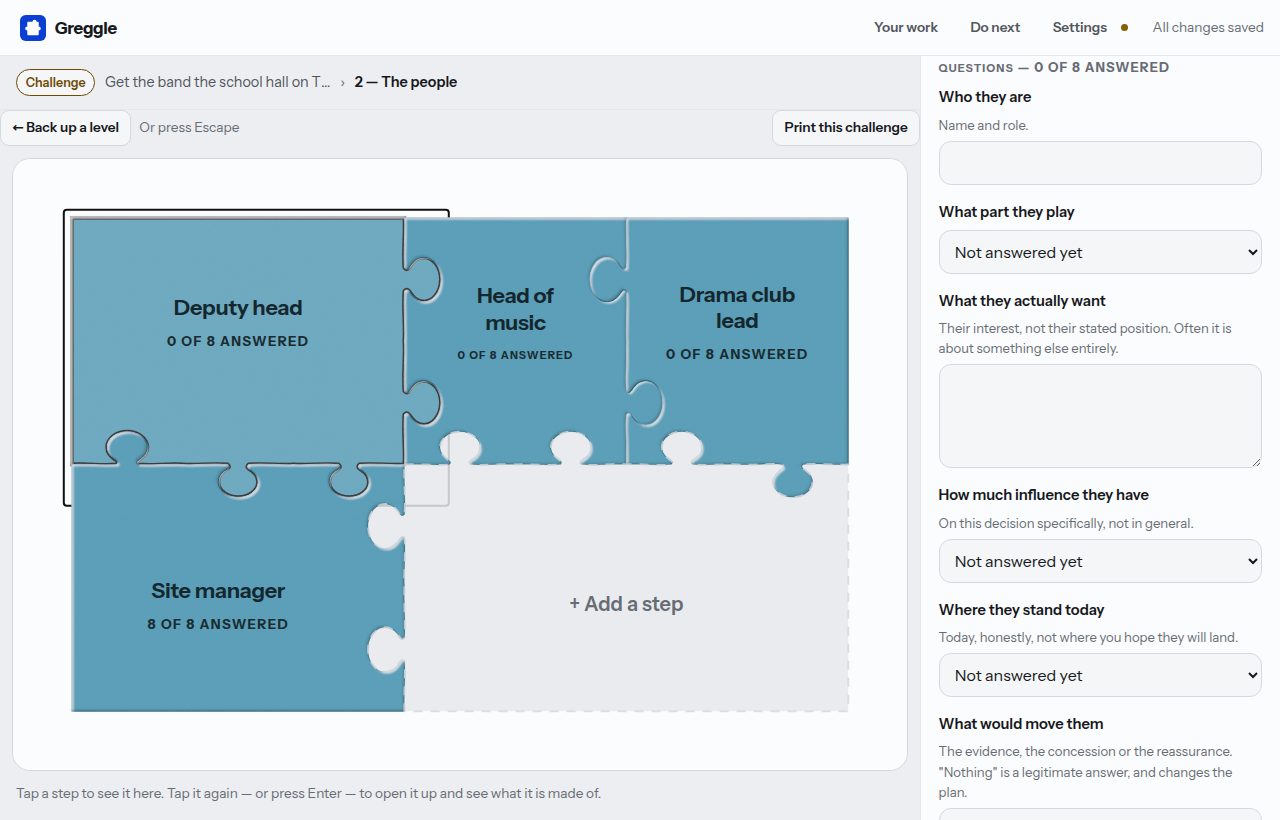
Nothing is added until you have looked at it. Open any step and it becomes a board of its own. Steps that cannot sensibly be cut smaller get marked as actions, and every action collects in one flat list.
What the check looks for
One button reads the whole branch back. On this method it reports, among other things:
- Nobody on this map is opposed, which usually means it records what people said in the room rather than what they will do outside it.
- Someone is opposed, or sceptical, and nobody is going to talk to them.
- The person who decides this has a blank where what they want should be. Everything else is a way of getting to their yes.
- Everyone carries the same influence rating, so the map cannot say who to see first.
A worked example
The person with the most influence turned out to be the one with no formal role, and what he actually wants has nothing to do with the band. Nobody would have found that by asking who is in charge.
Where it falls down
People aren’t fixed points. Positions shift after every conversation, and a map made once and never revisited describes a room that no longer exists. Revisit it after each conversation, and be careful what you write down about named people, even on your own machine.
The other failure is diplomacy. A map that records what people said rather than what they want, and that has nobody opposed on it, is comforting and useless. The candour is the method; the grid is just where you put it.
Pairs well with
- Force Field Analysis. When the restraints are people, this is how you find out what each of them actually wants.
- Answer First. Once you know what the decider wants, the case you put to them starts with the answer and the reason they care about.
- Scenario Planning. The signposts are often people. Who would know first?
Further reading
- R. Edward Freeman, Strategic Management: A Stakeholder Approach, 1984.
- Aubrey L. Mendelow, "Environmental Scanning: The Impact of the Stakeholder Concept", Proceedings of the International Conference on Information Systems, 1981. The power and interest grid.
Map the room you actually have. Then decide who to talk to first.
This opens the app with the kind already chosen. Give the thing a name, press Start, and Stakeholder and Influence Map is proposed on the new board for you to look over before anything is added. Free, no account, works offline.
Open Greggle with Stakeholder and Influence Map