Greggle · Ways of thinking · Answer First
A way of thinking · best for a Challenge or a DecisionAnswer First
Give the answer in the first sentence, then group the reasons beneath it, parallel reasons or a chain, never both at once, with the evidence at the leaves.
Barbara Minto, 1970s
a Challenge, a Decision, at the end
An hour to get it into one sentence
An answer, and a reader who might stop early
Where it came from
Barbara Minto again. The Pyramid Principle’s second rule, after MECE, is that the answer goes at the top and the reasons hang beneath it, because a reader who knows the conclusion can judge the reasons, while a reader waiting for the conclusion can’t judge anything. She worked it out teaching McKinsey consultants to write in the late 1960s and published it in 1978, and it has been the house style of the consulting trade ever since.
The idea is older. Newspapers have written this way since the telegraph, when a story might be cut off at any line and had to survive it: the inverted pyramid. The military calls the same thing BLUF, bottom line up front. Minto’s contribution was the structure beneath the answer: a small number of groups, each asserting one claim, each argued one way, with the evidence at the leaves.
Greggle describes it as the presenting counterpart to the issue tree. One is how you work the answer out; this is how you deliver it.
Why it works
Writing the answer first exposes whether you have one. Most rambling explanations are rambling because the writer hasn’t decided, and putting the decision in the first sentence makes that impossible to hide. If it needs two sentences, it is two answers, and the work upstream isn’t finished.
The rest is built for the reader who may stop at any line. The first sentence alone gives the answer. The three claims alone give the case. The full depth gives the proof. And each group argues one way: parallel reasons survive reordering and the loss of one; a chain survives neither; mixed together, the reader can rely on nothing.
When to reach for it, and when not to
Reach for it at the end of anything: a Decision made that now has to be explained to someone, a Challenge where someone else has to be persuaded, a Problem diagnosed that someone else has to act on. It is the method for the last step, once the thinking is done.
It is the wrong tool when you don’t yet have an answer; that is what the issue tree is for, and Greggle’s own rule is to go back to the tree if the answer won’t fit in one sentence. Greggle suggests it on a Challenge and on a Decision, last in both lists.
How to run it
With a pen, on one sheet of paper.
- Write who this is for, what they already believe, and what they will do with the answer. Then write the question they are asking, in their words. Answering a better question than the one asked reads as evasion.
- Write the answer in one sentence. The whole recommendation, as the first thing they read. If it won’t go in one sentence, go back to the thinking.
- Write three groups beneath it, each asserting one claim in a sentence that directly holds the answer up. Order them by strength. Two groups is usually a debate; four is usually a list.
- Fill each group with two to five supports that argue alike: all parallel reasons, or all steps in a chain. Never both in one group. Put the evidence, the fact or figure or source, behind each support.
- Test each support: if this fell, would the claim still stand? If yes, it is colour, not support, and it moves to an appendix or goes.
- Read it as the reader will. Write the thirty-second version: the answer, the three claims, nothing else. Then write the strongest objection and say which group answers it. If none does, you are missing a group.
There is a one-page card with these steps and a blank grid to fill in, made to print on A4. Or the PDF.
On a Greggle board
Pick Answer First on a Challenge or Decision board and Greggle proposes the answer, three groups each with two supports to start, and the read-through. Each group takes up to five supports.
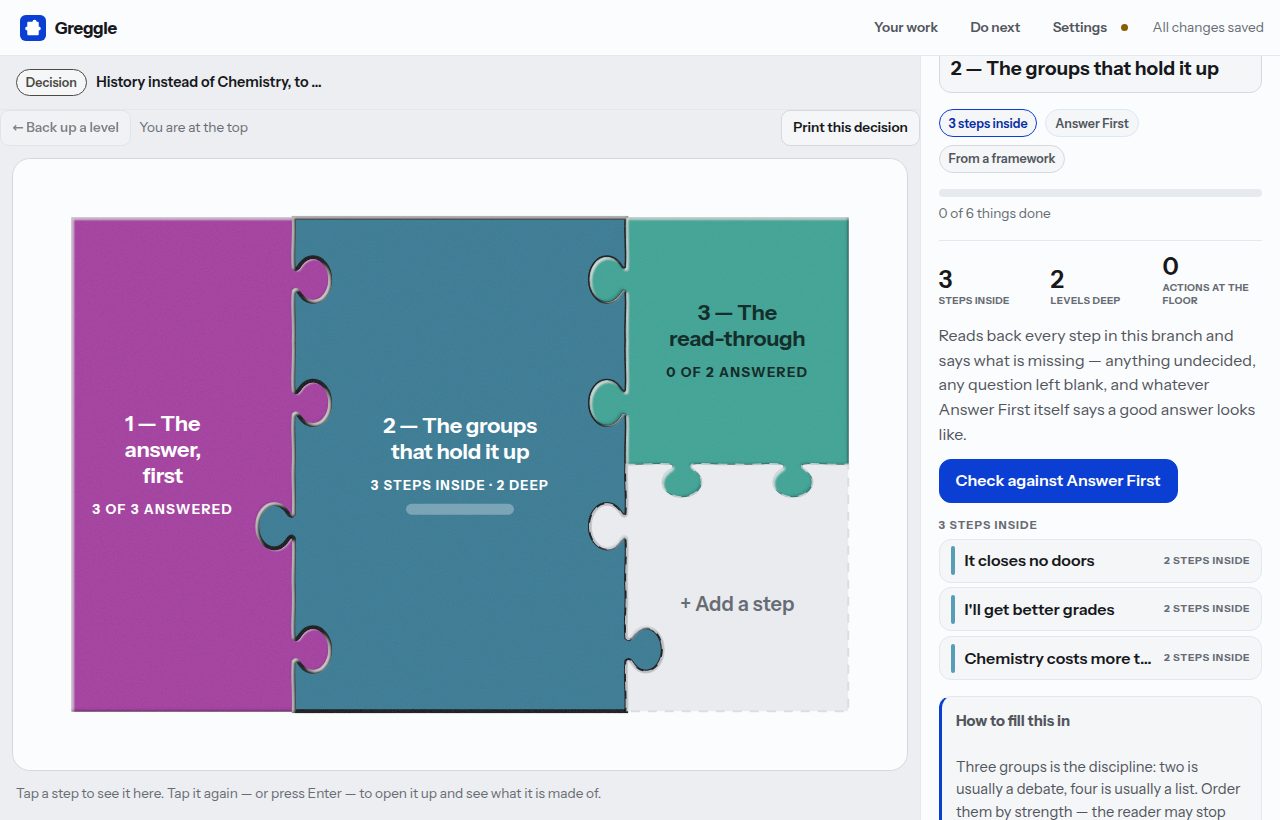
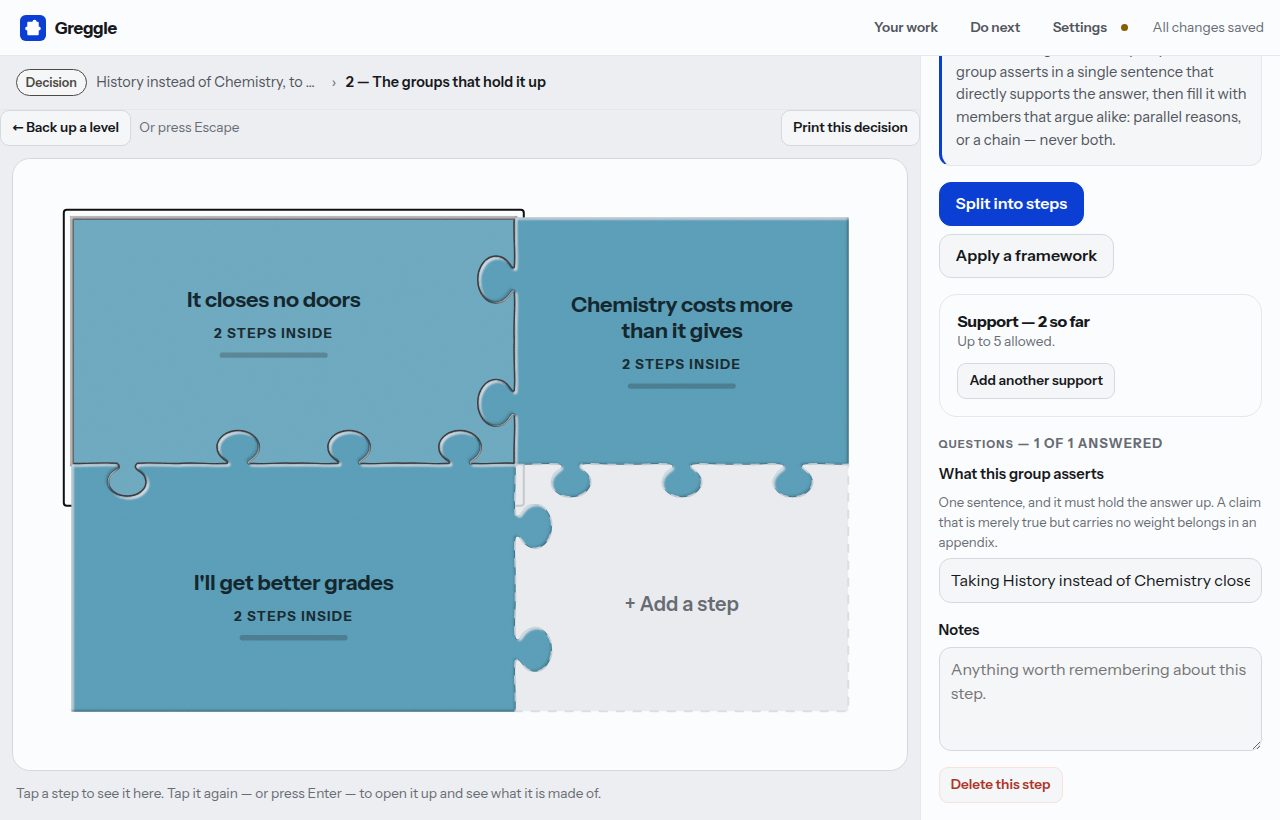
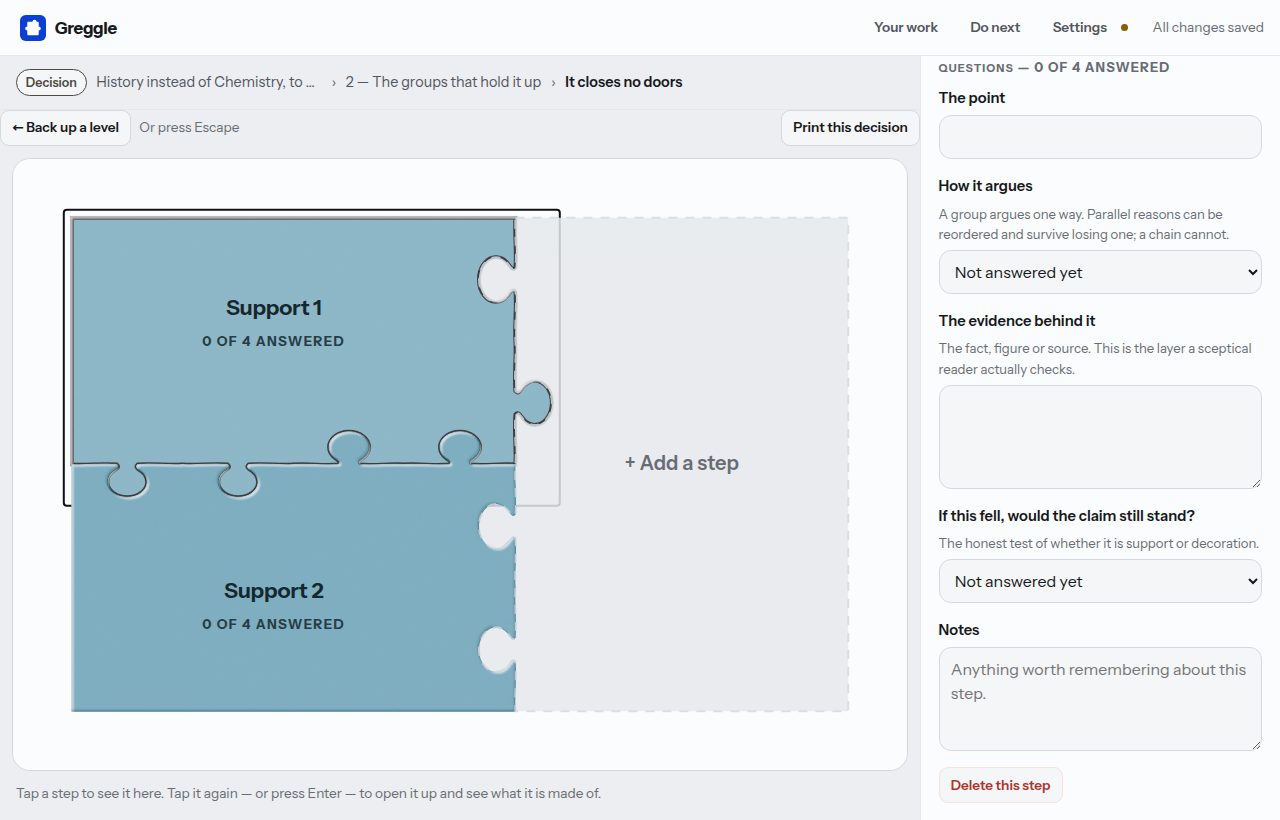
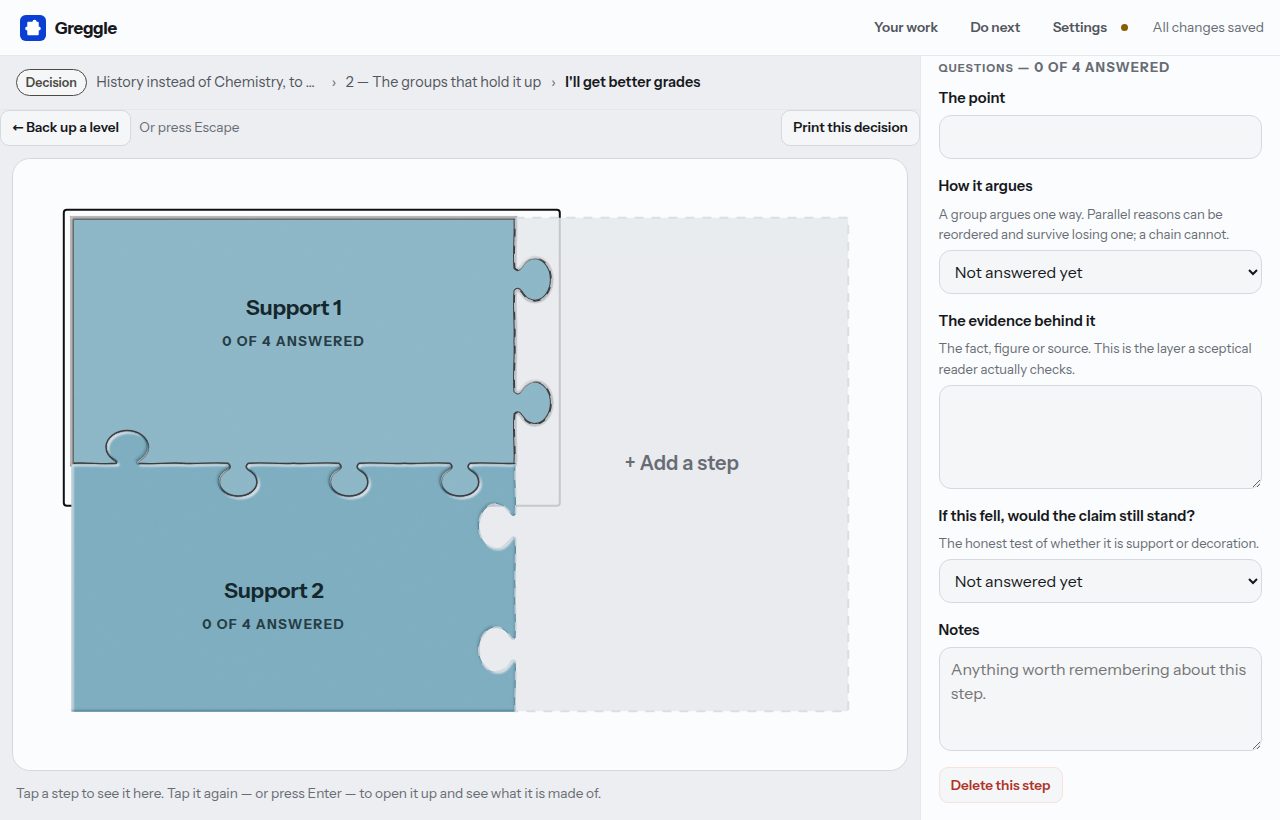
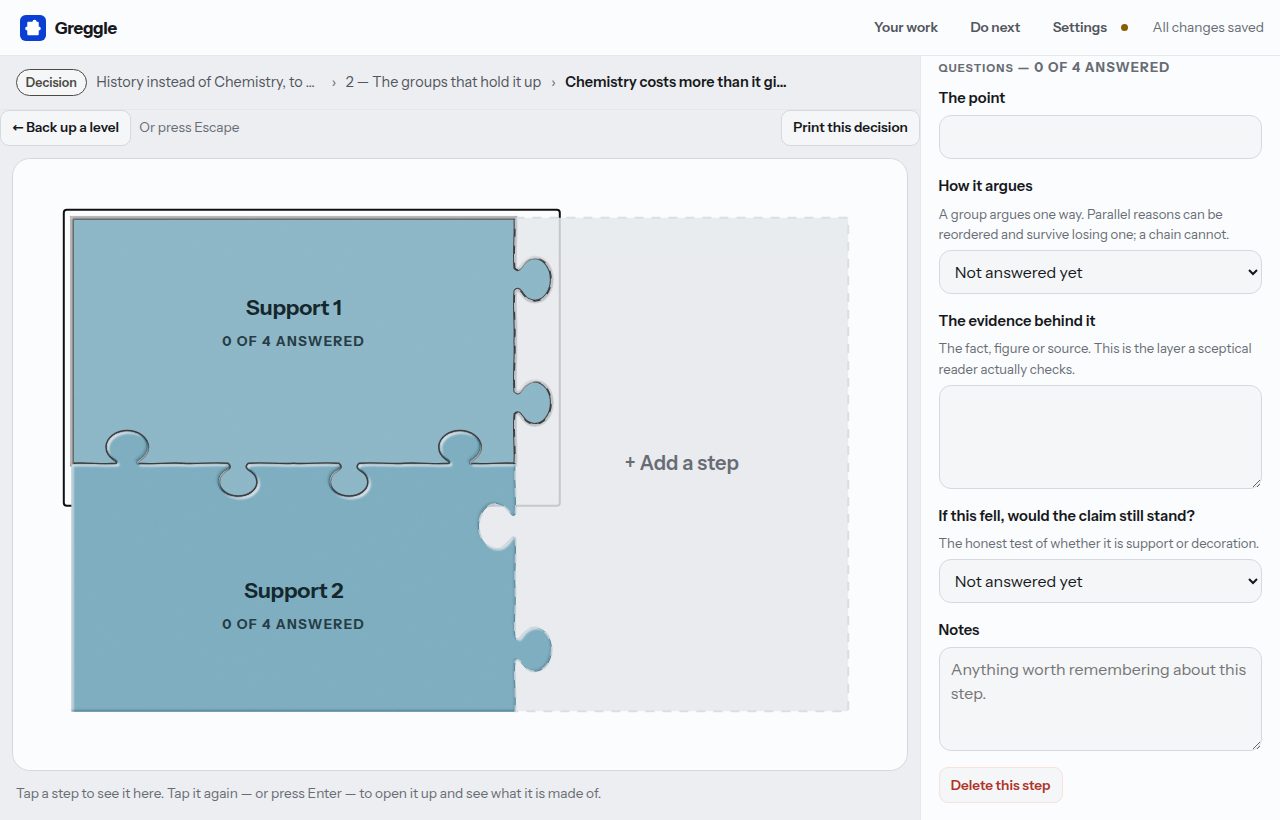
Nothing is added until you have looked at it. Open any step and it becomes a board of its own. Steps that cannot sensibly be cut smaller get marked as actions, and every action collects in one flat list.
What the check looks for
One button reads the whole branch back. On this method it reports, among other things:
- A group mixes parallel reasons with steps in a chain, so the reader cannot tell what it survives and trusts none of it.
- A group’s supports are all assertion, with no evidence behind any of them.
- By your own account, the claim would survive losing every member of a group, which means the group is standing near it, not holding it up.
A worked example
The first draft opened with the reasons and got to the answer in paragraph three, which is how these conversations usually go and why they usually go badly. The parents can stop after the first sentence and still know what is being asked.
Where it falls down
Answer first with nothing beneath it is an assertion, and a confident one is worse than a hesitant one. The pyramid has to have a base, and the base has to be evidence a sceptical reader could check, not more assertions in smaller type.
The other failure is the group that isn’t load-bearing: true, relevant-sounding, and unnecessary. If the claim would survive losing every support in the group, the group is decoration, and the reader will notice before you do. Three groups is the discipline because it forces you to choose.
Pairs well with
- Issue Tree. The same method from the other end. Build the tree to find the answer, then turn it upside down to deliver it.
- Options and Criteria. Once chosen, the comparison is the evidence at the leaves. The answer goes at the top.
- Stakeholder and Influence Map. Who this is for is the first field. Find out what they actually want before you write the sentence.
Further reading
- Barbara Minto, The Pyramid Principle, 1978; current edition The Minto Pyramid Principle, 2009. The first half is this method.
- Any newspaper style guide on the inverted pyramid, which is the same idea a century earlier.
Say the answer in one sentence. Then hold it up.
This opens the app with the kind already chosen. Give the thing a name, press Start, and Answer First is proposed on the new board for you to look over before anything is added. Free, no account, works offline.
Open Greggle with Answer First