Greggle · Ways of thinking · Issue Tree
A way of thinking · best for a Challenge, a Problem or a DecisionIssue Tree
State the question, split it into parts that do not overlap and leave nothing out, then test the parts that would actually change the answer.
McKinsey, 1960s
a Challenge, a Problem, a Decision
An hour for the first split
A question, and your best answer to it today
Where it came from
McKinsey, and specifically Barbara Minto, who joined the firm in 1963 as one of its first women consultants and was soon asked to teach the others how to write. What she taught was a way of organising thought: any question can be broken into a small number of parts, and a breakdown is only trustworthy if the parts are mutually exclusive and collectively exhaustive. No overlaps, no gaps. The consulting world still says MECE, pronounced "mee-see", and still means her rule.
Her book The Pyramid Principle came out in 1978 and has never gone out of print. The issue tree is the working end of it: the question at the top, the parts beneath, each part split again until the leaves are things you can check. The other half of her book, how to present the answer once you have it, is the method Greggle calls Answer First.
The habit of writing your best answer before you start comes from the same firm. A tree built without a hypothesis finds whatever it was pointed at, and takes far longer doing it.
Why it works
A question split into non-overlapping parts can be worked on in pieces, by different people, in any order. The "nothing left out" test catches the branch you forgot about before it becomes the reason the plan failed. And a branch that says what would have to be true, and how you would test it, can be closed. Most questions stay open for years because nobody ever wrote down what would settle them.
Greggle is built in this shape. Every board is a split, and every step is a branch you can open and split again. The issue tree is the method that says out loud what the app does quietly, and adds the two questions the app can’t ask for you: does this branch overlap another, and would it change the answer?
When to reach for it, and when not to
Reach for it when a question is too big to see whole, when several people disagree about it and you suspect they are answering different parts, or when you want to know what to check first. It suits a Challenge, a Problem that has many possible causes, and a Decision where the options haven’t yet been separated from the reasons.
It is the wrong tool when the question is really a chain of causes, which is 5 Whys, or when the answer depends mostly on how the future turns out, which is Scenario Planning. Greggle suggests it on a Challenge, a Problem and a Decision.
How to run it
With a pen, on one sheet of paper.
- Write one question, singular and answerable. Then write your best answer today, before you start, and who decides what once it is answered. If nobody would do anything differently, swap the question for one where they would.
- Split the question into two to six parts. Test the split: could a fact belong to two parts? Is there a fact that belongs to none? Write down what the split leaves out, and why you cut it this way rather than the obvious other way.
- For each part, say what would have to be true for it to hold, stated so that it could turn out false, and how you would actually test it. "More analysis" is not a test.
- Judge each part: if it holds, does it settle the question, narrow it, or barely move it? Most parts are not decisive. If you have marked them all decisive, you have marked none.
- Open the parts that would change the answer and split them again. Leave the others whole. Depth on the interesting branch instead of the decisive one is the commonest failure.
- Pick the test to run first: the one that moves the answer furthest for the least effort. Give it a date and write down what result would change your mind.
There is a one-page card with these steps and a blank grid to fill in, made to print on A4. Or the PDF.
On a Greggle board
Pick Issue Tree on a Challenge, Problem or Decision board and Greggle proposes the question, the first split with three branches, and what to test first. The depth comes from you: open any branch and split it again.
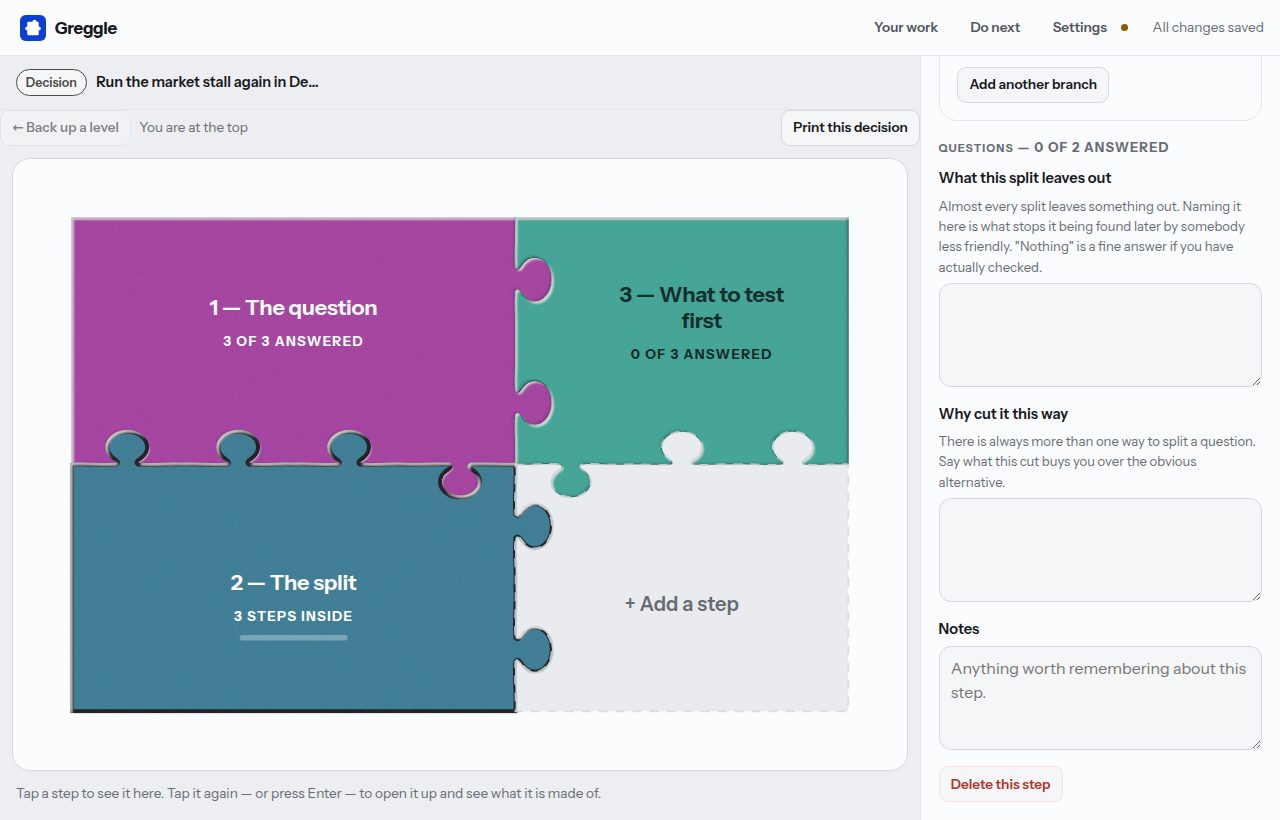
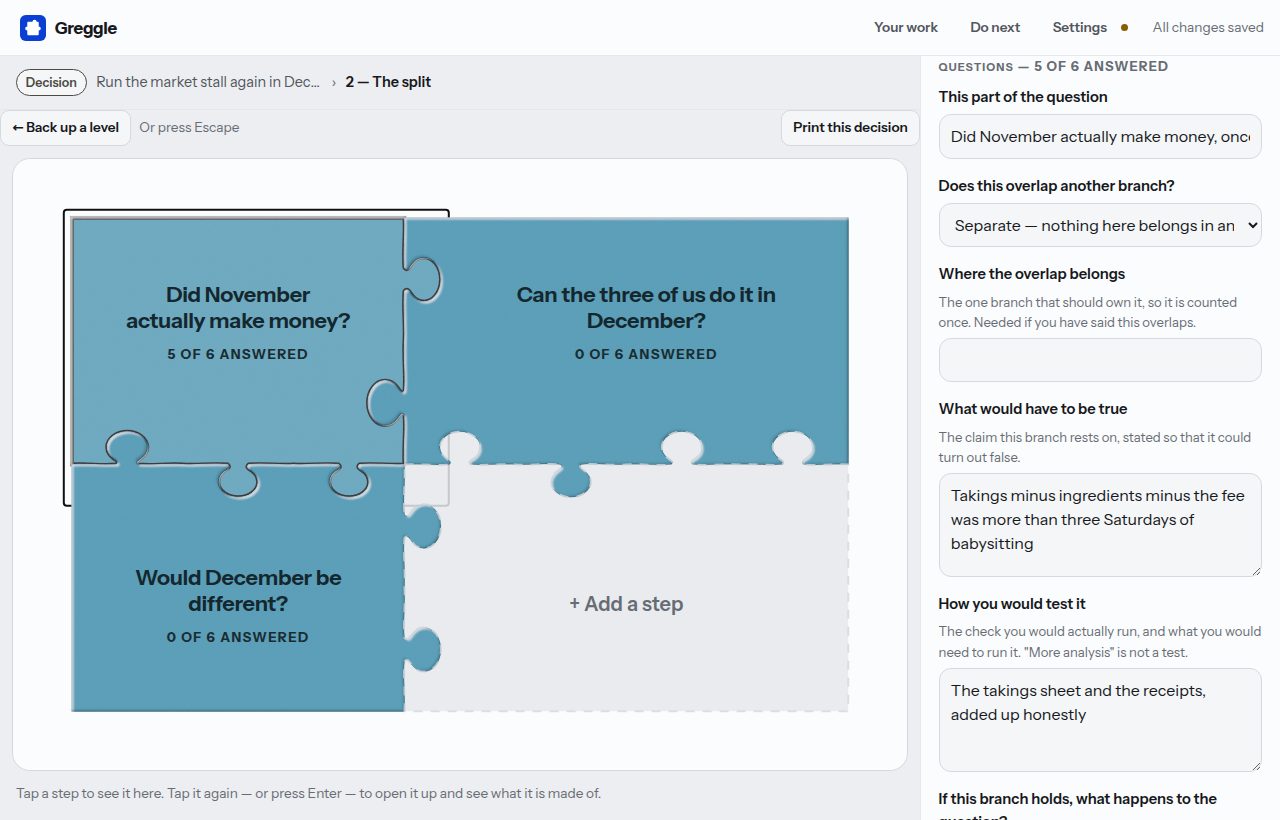
Nothing is added until you have looked at it. Open any step and it becomes a board of its own. Steps that cannot sensibly be cut smaller get marked as actions, and every action collects in one flat list.
What the check looks for
One button reads the whole branch back. On this method it reports, among other things:
- Branches have been written and not one says whether it overlaps another. Overlap does the most damage here, because the same thing gets counted twice.
- Not one branch says how it would be tested. A tree made of untestable branches organises the question without ever answering it.
- None of the branches would settle the question, or all of them carry the same weight, so the tree cannot say what to do first.
- One branch has been taken several levels down while another has not been opened at all.
A worked example
The best answer was yes. The first test was the one most likely to make it no, which is the right test to run first. Notice that branch 3 turned out to overlap branch 1, and saying which owns the overlap is what stops the 6am problem being counted twice.
Where it falls down
Perfect MECE is rarely achievable and chasing it wastes time. Good enough is "I can see no overlap and I can’t think of a gap", written down, with what the split leaves out named honestly. A split that claims to leave out nothing without having checked is worse than one that admits what it skipped.
The other failure is depth in the wrong place. The interesting branch gets four levels; the decisive branch gets none. The judgement on each branch, settles, narrows or barely moves, is there to stop that, and it only works if most branches are honestly marked as not decisive.
Pairs well with
- Answer First. The other half of Minto’s book. The tree is how you work the answer out; Answer First is how you deliver it.
- Cause and Effect. When the question is "why did this happen", the fishbone is an issue tree with the first split already chosen for you.
- First Principles. When you can’t find a split that isn’t inherited from how everyone else frames the question, strip the assumptions first.
Further reading
- Barbara Minto, The Pyramid Principle, 1978; the current edition is The Minto Pyramid Principle, 2009. The logic-tree chapters are the issue tree.
- Ethan Rasiel, The McKinsey Way, 1999, on hypothesis-first problem solving, which is where "your best answer today" comes from.
Split it honestly. Then test the branch that matters.
This opens the app with the kind already chosen. Give the thing a name, press Start, and Issue Tree is proposed on the new board for you to look over before anything is added. Free, no account, works offline.
Open Greggle with Issue Tree