Break a big thing into pieces small enough to just do.
Name something you are trying to work out. Greggle cuts it onto a board of interlocking steps. Open any step and it becomes a board of its own — keep going until every piece is something you can actually go and do.
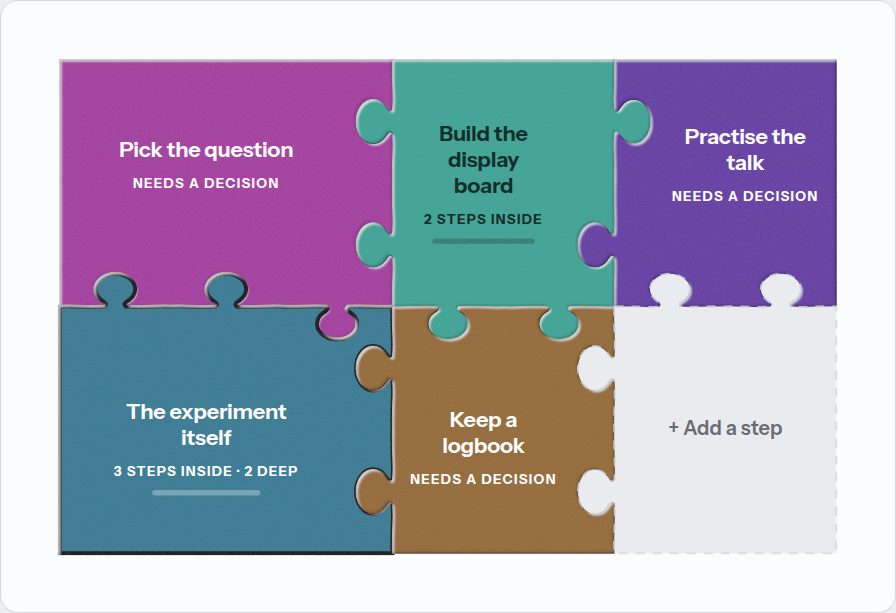
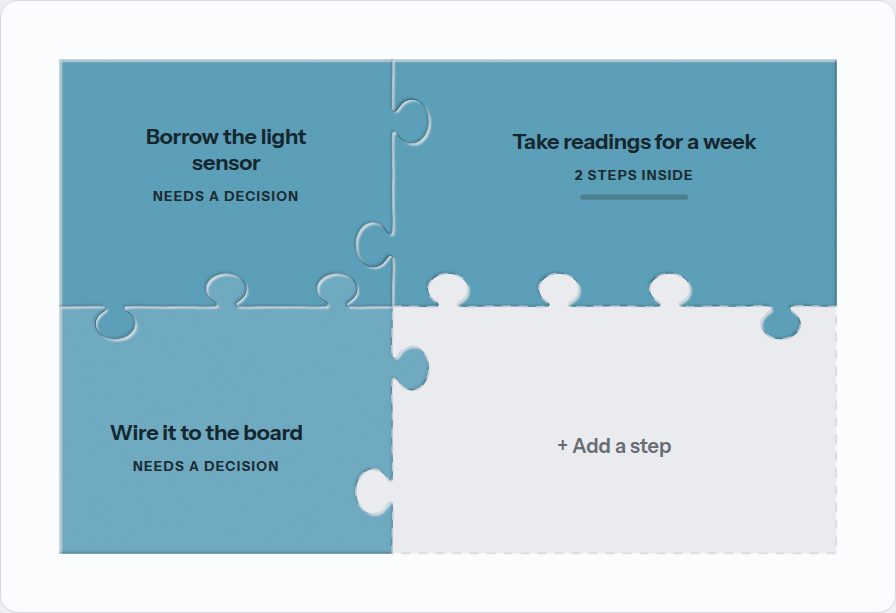
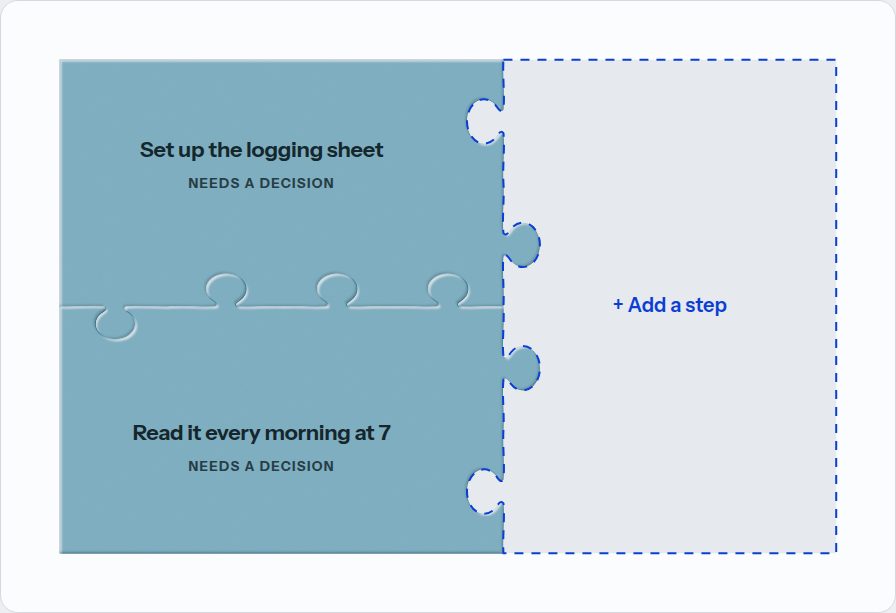
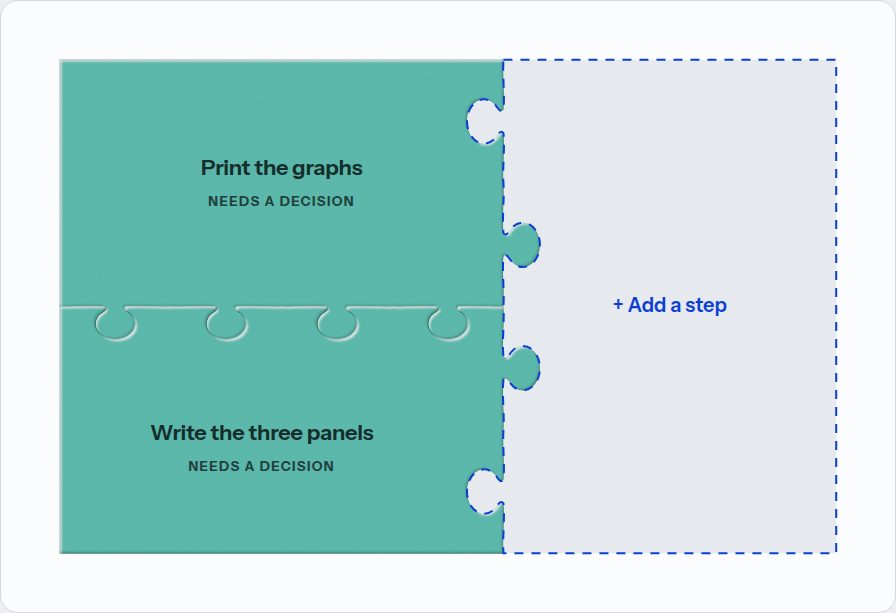
Three moves, repeated until the work is small.
Say what kind of thing it is
A Goal, a Project, a Challenge, a Problem, a Decision, an Opportunity or a Risk. The kind changes the questions you are asked and the ways of thinking you are offered.
Cut it into steps
By hand, or by picking a way of thinking — it proposes a cut and nothing is added until you have looked at it. Open any step and it becomes a whole board of its own.
Do the list
Any step that cannot sensibly be cut smaller gets marked as an action, and every action collects in one flat list. 3 of 11 things done — the counts, not just a bar.
Not everything breaks down the same way.
A goal is not a problem, and a decision is not a risk. Greggle asks what kind of thing you are working on first, because the kind decides what good questions look like. More about the eleven.
a Goal
Something you are aiming at, without a fixed end date.
say… Make the first team this season.
a Project
Something you are setting out to do that finishes.
say… The science fair project.
a Challenge
Something difficult to win, where the outcome is not yours to control.
say… The debating final.
a Problem
Something that has gone wrong and needs diagnosing.
say… The band keeps missing practice.
a Decision
A choice between options.
say… Which subjects to take next year.
an Opportunity
Something that might be worth pursuing, before you have decided to.
say… A stall at the Saturday market.
a Risk
Something that could go wrong, and has not yet.
say… What if the venue cancels?
a Habit
Something you want to do, or stop doing, without deciding every time.
say… Practise before school every day.
a Skill
Something you want to get properly good at, not just do.
say… Solder a clean joint every time.
a Conversation
Something you have to say to someone, and are dreading.
say… Asking the coach why I was dropped.
a Document
Something that has to persuade or explain, and is not yet written.
say… The personal statement.
None of them were invented here. That is the point.
These are the methods factories, consultancies and labs have used for decades — the ones normally locked inside textbooks and training courses. Greggle lays them out on your board and walks you through them. Pick one and it proposes a cut; nothing is added until you have reviewed it.
5 Whys
Began on Toyota’s factory floor in the 1950s
Ask why of the answer, five times, until you reach a cause you can actually act on.
Working Backwards
How Amazon starts new products
Define what done looks like and the evidence that would prove it, then walk back to now.
Pre-mortem
Psychologist Gary Klein’s insurance against wishful thinking
It is twelve months from now and this failed. Work out why, then prevent it.
First Principles
Aristotle’s method
Find the truths nothing else rests on, then build up from them alone.
Force Field Analysis
Psychologist Kurt Lewin, 1940s
What is pushing for the change, what is holding it back, and which single restraint you could actually remove.
Options and Criteria
The decision matrix, kept honest
Write down what a good answer would have to do before you look at the answers.
It reads your work back and says what is missing.
One button reads every step in a branch and reports what is undecided, what was asked and never answered, and what stops short of an answer. A percentage on its own flatters a plan, so the counts are always shown beside it.
No account. Nothing leaves your device.
There is nothing to sign up for. The app’s security policy blocks the internet outright and a test proves it makes no connections. Your work lives in your browser and in a file you own — the file is how it moves to another device.
The short answers.
What is Greggle?
Greggle is a free planning tool that helps you break something big into pieces small enough to just do. You name a goal, project, problem or decision, cut it into steps, and any step you cannot do yet opens into a board of its own.
Is Greggle free?
Yes. The app is free with no account, no limits and no expiry, and every one of its twenty-four thinking methods is included.
Do I need an account?
No. Greggle has no sign-up, no login and no password. You open it and start working.
Does Greggle collect any data?
No. Greggle has no server, no analytics and no tracking of any kind, and the app is blocked at browser level from making any outbound network connection. Your work stays in your browser and in a file you save yourself.
Does Greggle work offline?
Yes, completely. It installs as an app and works with no internet connection, because there is nothing it needs to connect to.
Does Greggle use AI to make the plan?
No. Greggle gives you proven thinking methods that ask you questions, rather than an AI that writes you a plan. The knowledge needed to answer them is already yours: only you know why your band misses practice.
How is Greggle different from a mind map?
A mind map spreads ideas out; Greggle cuts work down. Every piece is either something you can do or something that opens into smaller pieces, and everything you can actually do collects into one flat list.
What are the ways of thinking?
They are twenty-four structured methods for breaking a problem apart, including 5 Whys, Pre-mortem, Working Backwards, First Principles and Force Field Analysis. A method is a set of questions in an order that stops you lying to yourself. See them all.
Where is my work stored?
In your browser, on your device, and in a work file you can save and carry between devices. Nothing is uploaded, so nothing can be lost when a company changes its mind.
Can schools use Greggle?
Yes, and it is built for it: no accounts to provision, no student data collected, and nothing for a school to sign off before using it. Greggle for schools.
Who makes Greggle?
Greggle is built by Stuart Muir, an independent developer in Wellington, New Zealand.
Start with the thing you have been putting off.
Nothing is added until you add it, and you can delete the whole board when you are done with it.
Open Greggle