Greggle · Ways of thinking · Options and Criteria
A way of thinking · best for a DecisionOptions and Criteria
Write down what a good answer would have to do before you look at the answers, then say honestly what each one costs.
Franklin, 1772; Kepner and Tregoe, 1965
a Decision, an Opportunity
Half an hour
Criteria written before the options
Where it came from
Older than any company. In September 1772 Benjamin Franklin wrote to his friend Joseph Priestley, who was agonising over a job offer, and described what he called his moral or prudential algebra. Draw a line down a sheet of paper. Write the reasons for on one side, the reasons against on the other, over three or four days as they occur to you. Then strike out pairs of equal weight, a "for" against an "against", two weak ones against one strong one, until one side is empty. What remains is the answer, and it is an answer you can explain.
Charles Kepner and Benjamin Tregoe, two researchers who met at the RAND Corporation in the 1950s, turned the same instinct into a formal method for managers, published in The Rational Manager in 1965. Their decision analysis separates the criteria into musts, which any option has to satisfy or it is out, and wants, which are weighted and scored. Stuart Pugh’s concept selection matrix, from 1981, is the engineering version, where options are scored against a reference design rather than against each other.
Everyone has seen the grid. What almost nobody does is fill it in in the right order. Greggle keeps the sequence and the must-or-want split, and drops the arithmetic on purpose: it asks which option wins on which criterion and what each one costs, because a weighted total hides the judgement you are actually making behind numbers nobody checks.
Why it works
The matrix is almost beside the point. The sequence is the method. If you list the options first, the one you already like starts writing its own criteria: it is fast, so speed becomes a criterion; it is cheap, so cost becomes one. By the time you compare, the answer was decided before the grid existed, and the grid is just an alibi.
Writing down what a good answer would have to do, before any answer is on the table, stops that. The musts do most of the work: options that fail one are gone, and often that leaves two. Then the honest question is what each survivor costs. An option that loses on nothing was written after the conclusion.
When to reach for it, and when not to
Reach for it when there is a genuine choice between several things and you can feel your preference pulling you before you have thought. It suits a Decision above all, and an Opportunity where the choice is whether to pursue it at all, with "do nothing" as one of the options.
It is the wrong tool when there is only one option and the question is whether to take it; that is Force Field Analysis. It is also weak on a choice whose outcome depends heavily on things outside your control, where Scenario Planning does better. Greggle suggests it on a Decision and on an Opportunity.
How to run it
With a pen, on one sheet of paper.
- Write the choice: what is being chosen, by when, and what is not on the table. Name the decision, not the outcome you are hoping for.
- Before listing any option, write the criteria. For each, say whether an option must meet it or you would merely like it to, and how you would tell. Check that no two measure the same thing; if they overlap, say which one owns it.
- Only now list the options. At least three, and one of them is doing nothing. Deferring counts, if you say what you are waiting for.
- Strike out any option that fails a must, whatever else it does.
- For each survivor, say what it wins on, naming the criteria rather than qualities, and what it costs. No totals. Every option gives something up.
- Make the call: one option, why it over the runner-up, and what would reverse it. Writing down what would change your mind now is what lets you change it later without a fight.
There is a one-page card with these steps and a blank grid to fill in, made to print on A4. Or the PDF.
On a Greggle board
Pick Options and Criteria on a Decision board and Greggle proposes the choice, then the criteria, then the options, then the call. The criteria come before the options on the board, and the check complains if you fill them in the other way round.
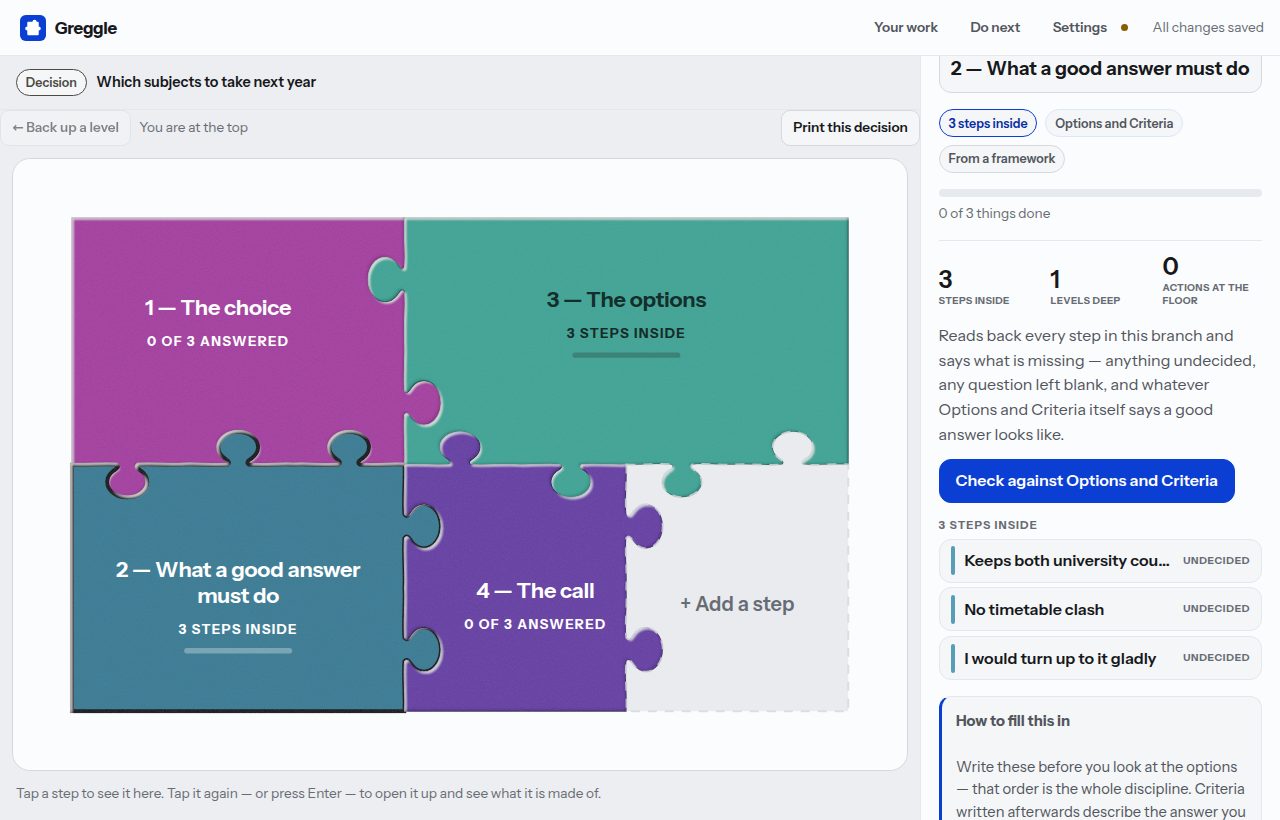
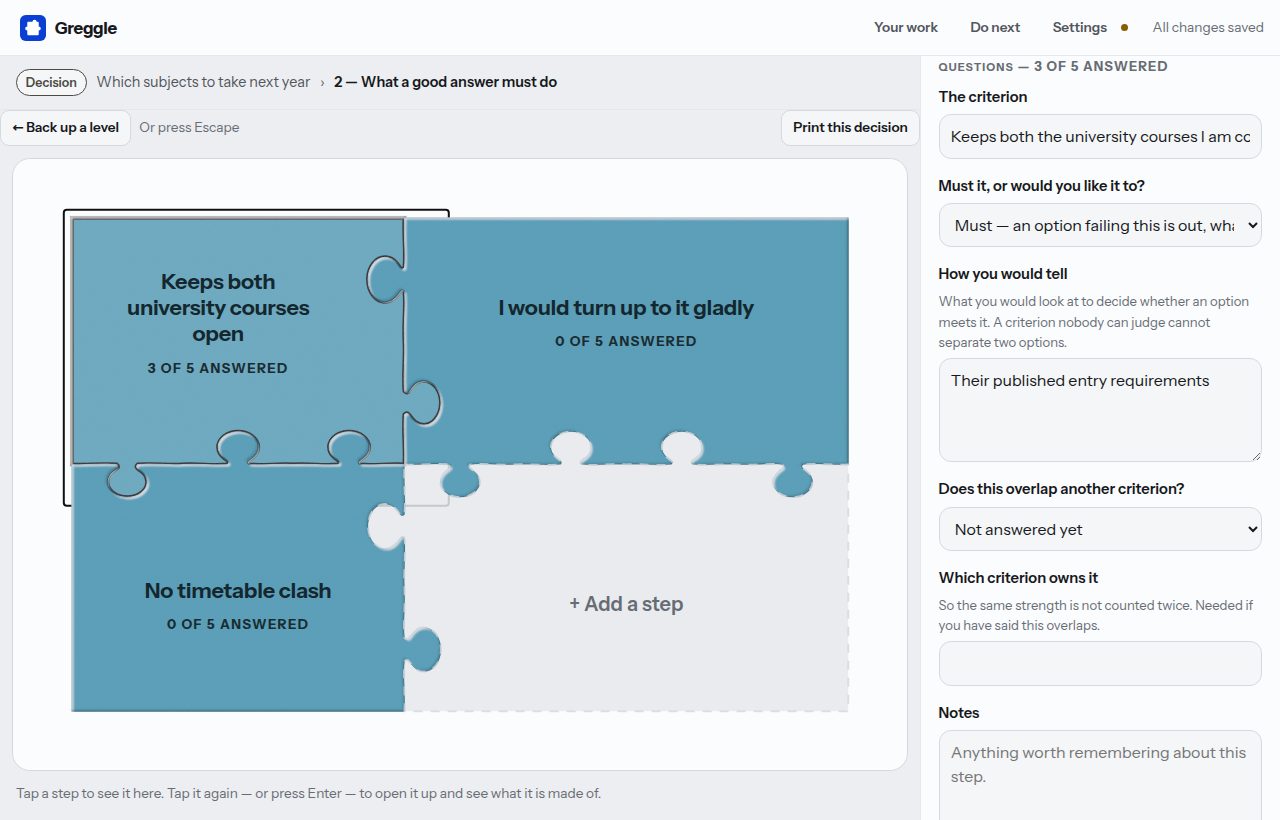
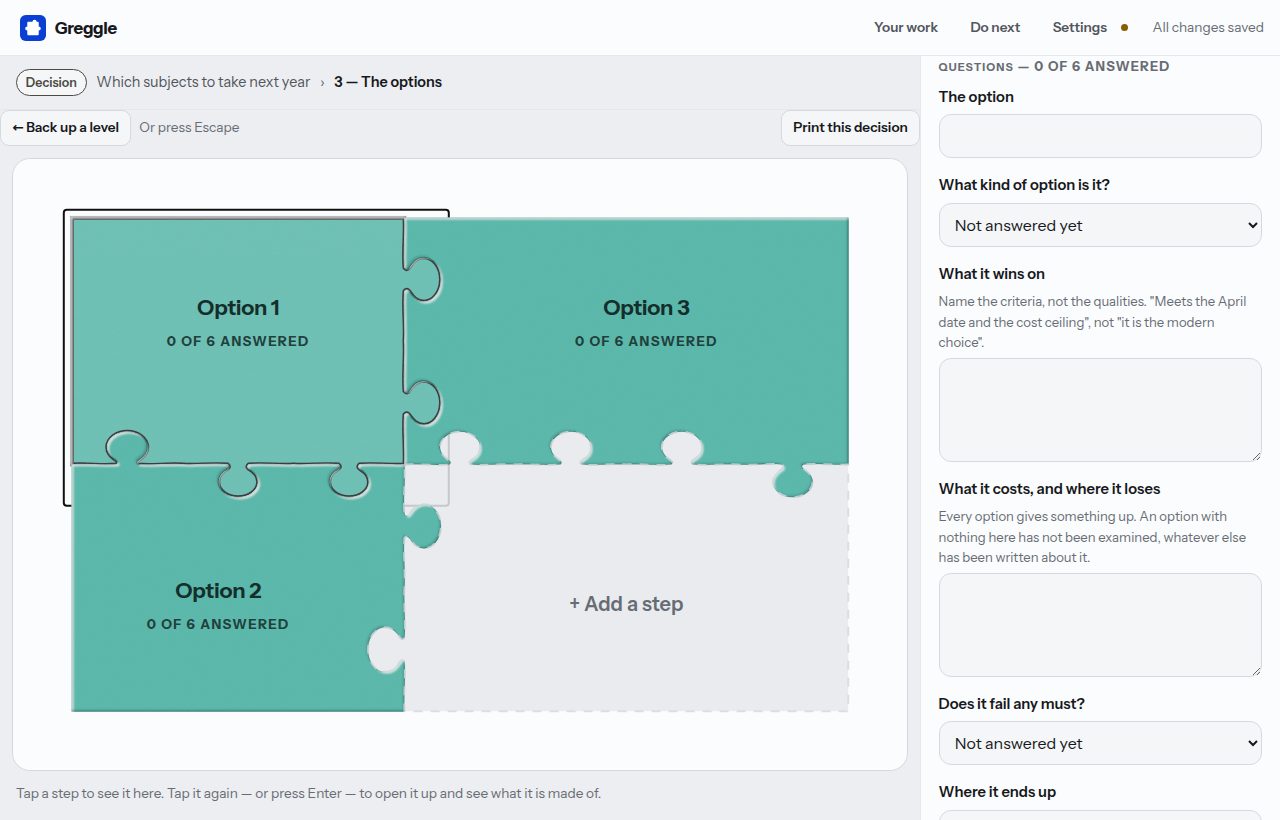
Nothing is added until you have looked at it. Open any step and it becomes a board of its own. Steps that cannot sensibly be cut smaller get marked as actions, and every action collects in one flat list.
What the check looks for
One button reads the whole branch back. On this method it reports, among other things:
- The options have been listed and what a good answer must do has not.
- Doing nothing is not among the options, so every option looks better than it is.
- Not one option says what it gives up, which is the signature of criteria written after the conclusion.
- The recommended option doesn’t say what it costs. Say it yourself before somebody else does.
A worked example
There are no numbers anywhere in that. The decision is in the sentences, where somebody can argue with it. A weighted grid would have put B ahead by six points and hidden the one thing that would reverse it.
Where it falls down
The classic weighted grid can be tuned until the favourite wins, and everyone who has used one has done it at least once. Greggle leaves the arithmetic out for that reason, but the same failure survives in words: an option with an empty cost line, criteria quietly rewritten after the options went in, doing nothing left off the list so everything else looks good against nothing.
The protection is the order, kept honestly, and the rule that every option costs something. If the option you recommend has no cost you can name, you haven’t examined it, and the first person you show it to will find the cost for you.
Pairs well with
- First Principles. Greggle calls this the missing half of that method. First principles generates three approaches; this is where they get compared.
- Scenario Planning. If the best option changes depending on how the world turns out, judge the options in each future, not just one.
- Answer First. Once chosen, say it in one sentence with the reasons beneath. The comparison is the evidence, not the answer.
Further reading
- Benjamin Franklin, letter to Joseph Priestley, 19 September 1772. One page, and worth reading in full.
- Charles H. Kepner and Benjamin B. Tregoe, The Rational Manager, 1965. Decision analysis is the middle third.
- Stuart Pugh, Total Design, 1991, for concept selection; the method dates from his 1981 conference paper.
Decide what good looks like. Then look at the options.
This opens the app with the kind already chosen. Give the thing a name, press Start, and Options and Criteria is proposed on the new board for you to look over before anything is added. Free, no account, works offline.
Open Greggle with Options and Criteria