Greggle · Ways of thinking · Force Field Analysis
A way of thinking · best for a Decision or a stalled GoalForce Field Analysis
What is pushing for the change, what is holding it back, and which single restraint you could actually remove.
Kurt Lewin, 1940s
a Decision, a Goal that has stalled, an Opportunity, a Risk
Twenty minutes
Honesty about what is holding you back, and a name
Where it came from
Kurt Lewin was a German psychologist who left Berlin for America in 1933 and, in the fourteen years before his death in 1947, founded most of what is now called social psychology. He thought of any situation, a person, a group, a factory floor, as a field of forces held in balance. Some push towards a change; some hold it back. Nothing moves while they balance. Something moves when they don’t.
His observation, which is the whole method, is that there are two ways to unbalance the field, and they are not equal. You can push harder. Or you can remove something that is holding the change back. Pushing harder works briefly and raises resistance, because the restraining forces push back in proportion. Removing a restraint lets the change happen with the push you already have. Lewin’s papers were collected as Field Theory in Social Science in 1951, after he died. The analysis, drawn as two columns of arrows pointing at a line, has been used in change management ever since.
Why it works
It makes you write the things holding you back in a separate column from the things pushing you forward, and then it makes you choose one restraint to remove. Most people, when something has stalled, only ever add more push: more motivation, more reminders, more pressure. The restraints are still there, so the thing stays stalled and now everyone is tired.
Naming the restraints one by one, weighing them against each other and asking who could move each one shows that they are not all equal and that at least one is usually cheap to remove. That one, with a method and a name against it, is the action.
When to reach for it, and when not to
Reach for it when you are deciding whether to change something, or when a goal you have been pushing towards has stopped moving. It suits a change that involves other people particularly well, because the restraints are usually other people’s, and this makes you write them down as forces rather than as villains.
It is the wrong tool for choosing between several options; that is Options and Criteria. It is also weak on a change you don’t yet want, since the whole method assumes the push exists. Greggle suggests it on a Goal, a Decision, an Opportunity and a Risk, and first of all on an Opportunity.
How to run it
With a pen, on one sheet of paper.
- Write the change as a movement from one state to another, and be honest about what happens if nothing changes at all.
- Left column, everything pushing for it. Include the forces you did not create and do not control: a deadline, a rule, someone else’s decision. For each, say whose force it is.
- Right column, everything holding it back. Be specific enough that somebody could go and do something about each one. Include the ones that are about you.
- Weigh every force against the others: strong, moderate or weak. Words, not numbers, and relative, not absolute.
- For each restraint, ask: could it be removed entirely, weakened, or neither? For anything removable or weakenable, write who would do it. A name.
- Pick one restraint. Not the largest, the one where the effort you can actually spend produces the most movement. Say how it gets removed and what moves once it is gone. One restraint, one method, one name.
There is a one-page card with these steps and a blank grid to fill in, made to print on A4. Or the PDF.
On a Greggle board
Pick Force Field Analysis on a Goal or Decision board and Greggle proposes four steps: the change, what is pushing for it, what is holding it back, and the one to remove. Each column starts with three forces and takes up to twelve.
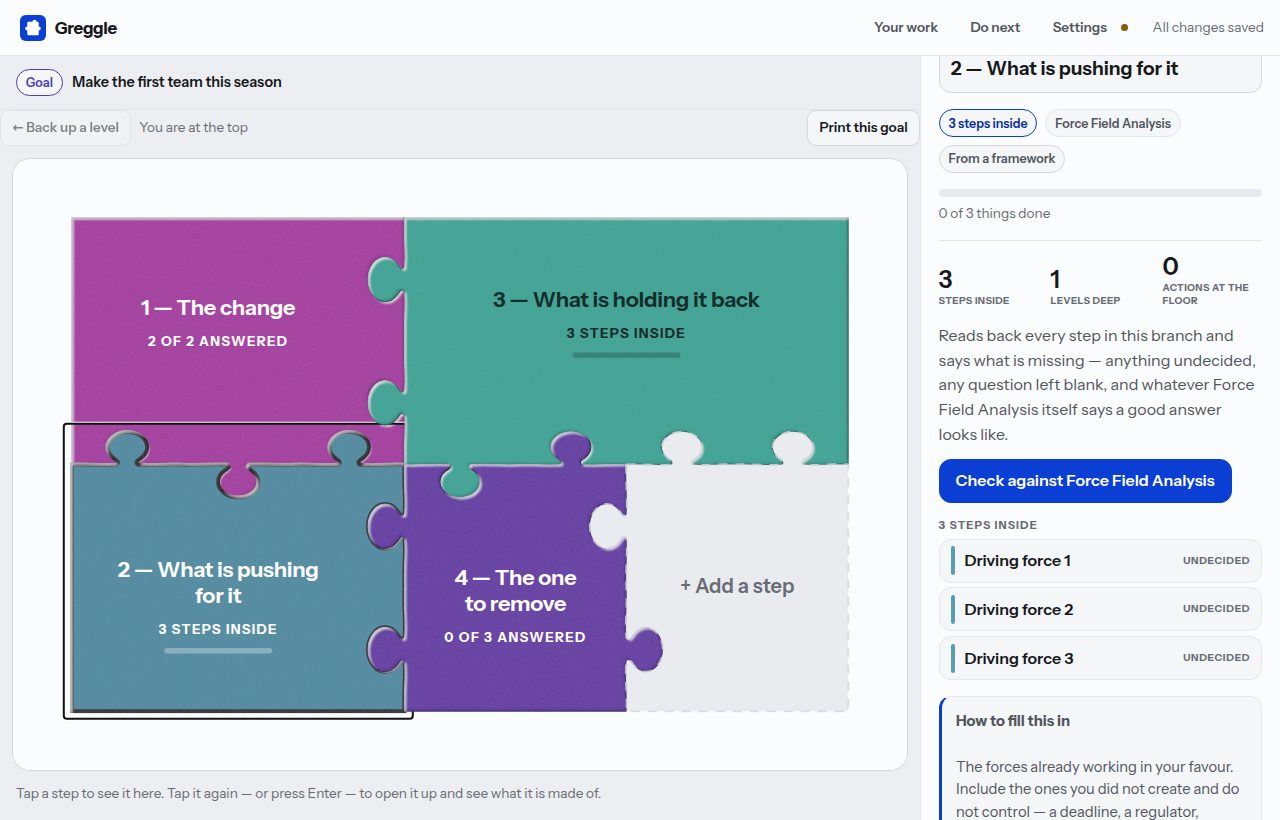
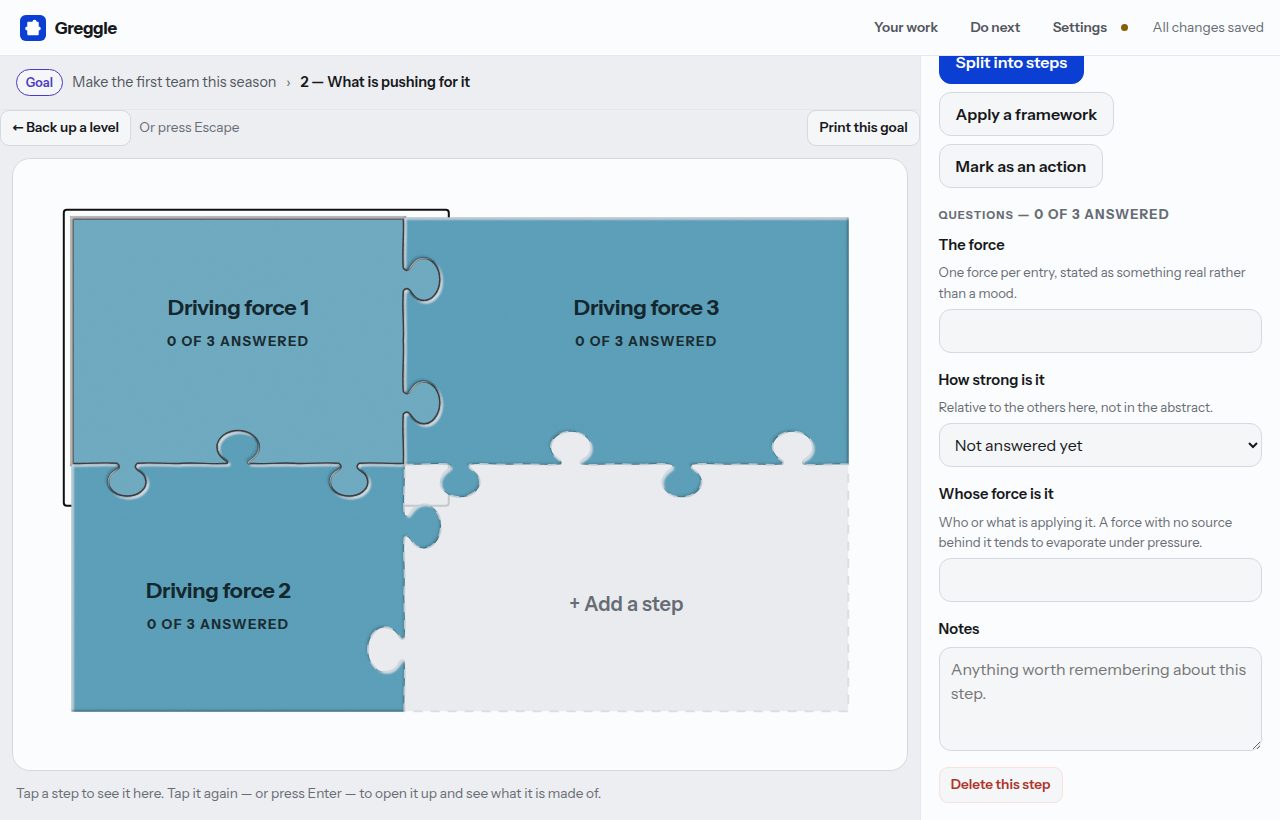
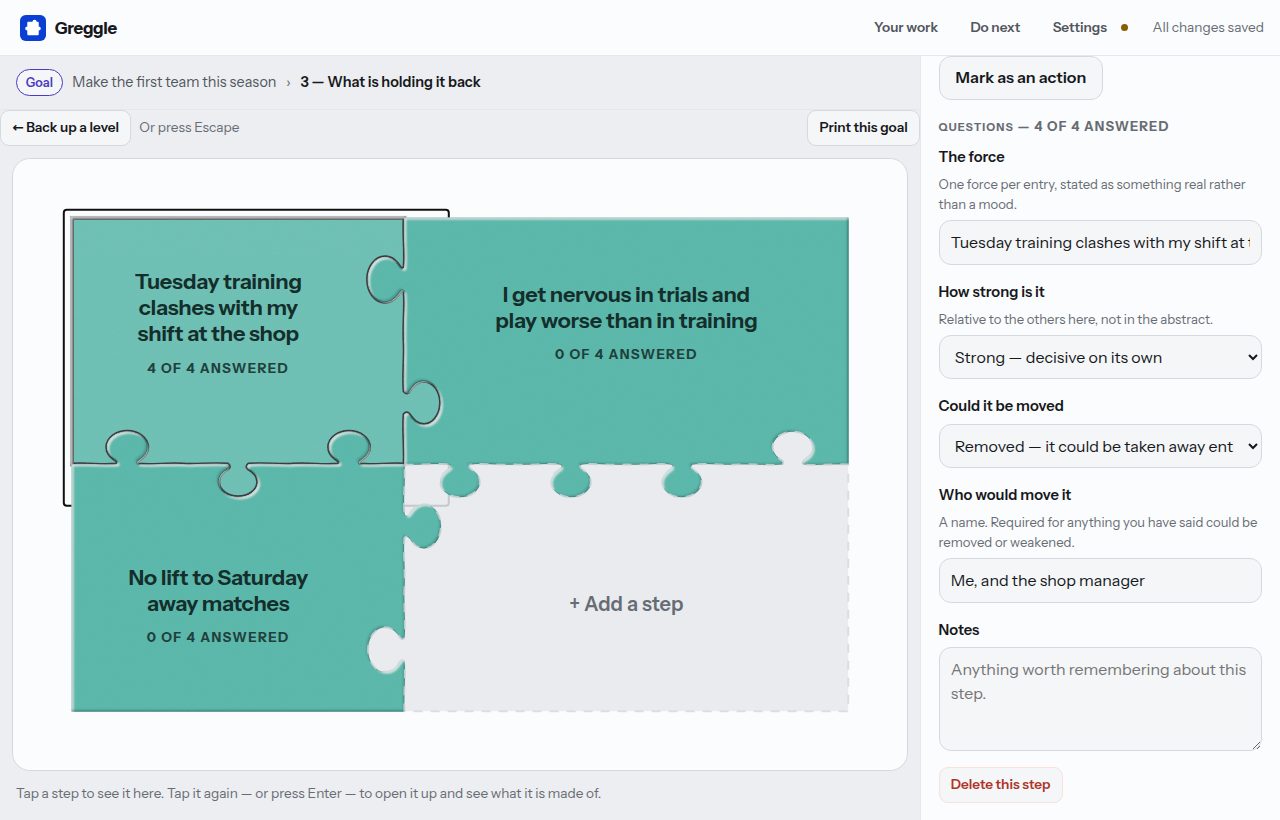
Nothing is added until you have looked at it. Open any step and it becomes a board of its own. Steps that cannot sensibly be cut smaller get marked as actions, and every action collects in one flat list.
What the check looks for
One button reads the whole branch back. On this method it reports, among other things:
- The forces for the change have been written out and the forces against it left blank. That is wishful thinking on paper.
- Forces have been listed and none is weighed against the others. An unweighted list says everything matters equally.
- A restraint you have judged removable has no name beside it, which is the commonest way this method produces a tidy board and no change.
A worked example
The change. From training with the seconds to being picked for the first team for the second half of the season. If nothing changes: another season in the seconds, and next year the year below start overtaking.
| Pushing for it | How strong | Whose force |
|---|---|---|
| Fitness is better than last year | Moderate | Mine |
| The coach has said I am close | Moderate | The coach |
| Two first-team players leave at Christmas | Strong | The calendar |
| A friend already on the team who talks me up | Weak | Sam |
| Holding it back | How strong | Could it be moved | Who would move it |
|---|---|---|---|
| Tuesday training clashes with my shift at the shop | Strong | Removed | Me, and the shop manager |
| No lift to Saturday away matches | Moderate | Weakened | Me, asking at Tuesday training |
| The current player in my position is popular | Moderate | Neither | Plan around it |
| I get nervous in trials and play worse than in training | Strong | Weakened | Me, slowly |
Left to itself, the instinct is to add push: train harder, want it more. The field says the fastest way to move is to stop missing Tuesdays.
Where it falls down
The classic version scores each force out of five, and people add the columns up, get 15 against 16, and conclude the change is impossible by one point. The scores were only ever there to rank the restraints. Greggle uses three words instead of numbers for exactly this reason: a ranking is what you need and a total is what misleads you.
It is also easy to fill the right-hand column with other people and leave yourself out. The restraint that is about you, the nerves in the example, is often the one that matters most in the long run even if it isn’t the one to remove first. Write it down anyway. And a restraint judged removable with nobody’s name beside it is a wish, not a plan.
Pairs well with
- Stakeholder and Influence Map. When most of the restraints are people, map them properly: what does each one actually want?
- 5 Whys. A restraint that is strong deserves to be asked why, five times. It may not be what it looks like.
- Options and Criteria. If the field shows the change is worth making, and there are several ways to make it, choose between them with criteria written first.
Further reading
- Kurt Lewin, Field Theory in Social Science, 1951, edited by Dorwin Cartwright. The force field is in the papers on group decision and social change.
- Kurt Lewin, "Frontiers in Group Dynamics", Human Relations, 1947. Where unfreezing, moving and refreezing first appear.
Stop pushing harder. Remove one thing that is holding it back.
This opens the app with the kind already chosen. Give the thing a name, press Start, and Force Field Analysis is proposed on the new board for you to look over before anything is added. Free, no account, works offline.
Open Greggle with Force Field Analysis