Greggle · Ways of thinking · 5 Whys
A way of thinking · best for a Problem5 Whys
Ask why of the answer, five times, until you reach a cause you can actually act on.
Toyota, 1950s
a Problem
Ten minutes
One person who was there
Where it came from
Toyota. The habit of asking why until the answer runs out is credited to Sakichi Toyoda, the inventor who founded the Toyota group, and it was Taiichi Ohno who made it a formal part of the Toyota Production System as he built that system through the 1950s and 60s. Ohno’s 1978 book gives the example everyone still uses. A machine stopped.
Why did it stop? A fuse blew, because the machine was overloaded. Why was it overloaded? The bearing was not lubricated enough. Why not? The lubrication pump was not pumping properly. Why not? Its shaft was worn and rattling. Why was the shaft worn? There was no strainer on the intake, so metal scrap had got into the pump.
Replace the fuse and the machine stops again next week. Fit a strainer and it doesn’t. Ohno’s point was that the first four answers are all true and none of them is the cause.
Why it works
Each answer becomes the next question, so you can’t stop at the first plausible cause. Most people stop there because the first cause is usually a real one, just not the one that matters.
The discipline is in refusing to accept a person’s mistake as an answer. Somebody forgot, somebody was late, somebody didn’t check. People will always forget and be late and not check, and you can’t fix that. You can fix the thing that made the mistake possible, or the thing that made it matter. So when an answer is "someone slipped up", ask why the slip was possible, and keep going.
When to reach for it, and when not to
Reach for it when something has gone wrong, ideally more than once, and you suspect the obvious explanation is only the surface. It is at its best on a single, specific event: this practice was missed, this deadline slid, this row happened.
Don’t use it on something that hasn’t happened yet, and don’t use it on a problem that feels wide rather than deep. If you can already think of four unrelated reasons, you have several chains, not one, and the fishbone is the better start. In Greggle, 5 Whys is the first method suggested on a Problem.
How to run it
With a pen, on one sheet of paper.
- Write the problem as one observed fact. Not "the band is flaky" but "we have missed four of the last six practices". Say how you know.
- Ask why it happened. Write one answer, a cause you could check, not the same event in other words.
- Ask why of that answer, not of the original problem. Write the next answer beneath it.
- Keep going. Whenever the answer is a person’s mistake, ask why the mistake was possible, or why it mattered.
- Stop when you reach something you could change tomorrow. Five is a guide, not a rule. Three is often enough, and if the fifth still isn’t something you can act on, the chain went sideways: start again from the first why.
- Write the change as an action. Then check it backwards: if that had been in place, would the chain have broken?
There is a one-page card with these steps and a blank grid to fill in, made to print on A4. Or the PDF.
On a Greggle board
Pick 5 Whys on a Problem board and Greggle first asks you to state the problem as an observable fact, then proposes five whys, each one nested inside the one before it, so every why is asked of the answer above and not of the original problem.
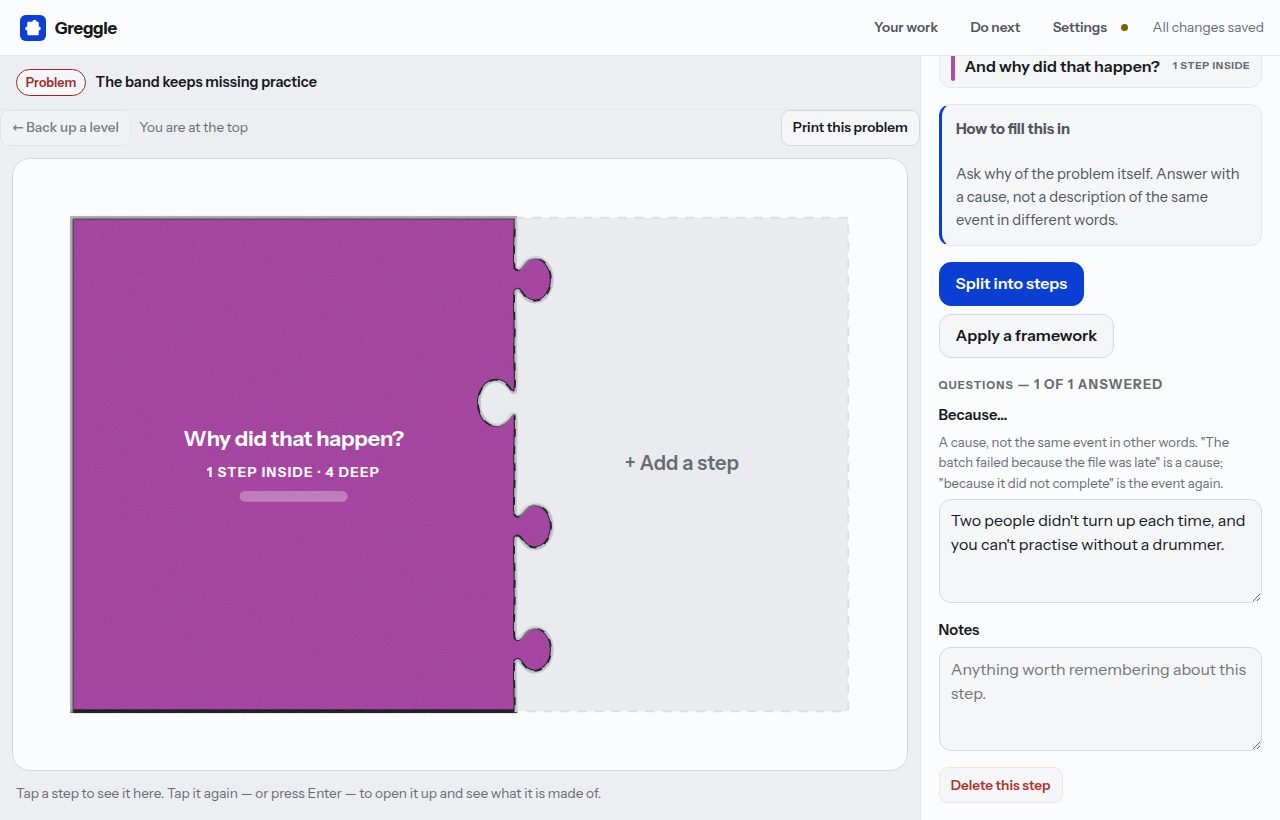
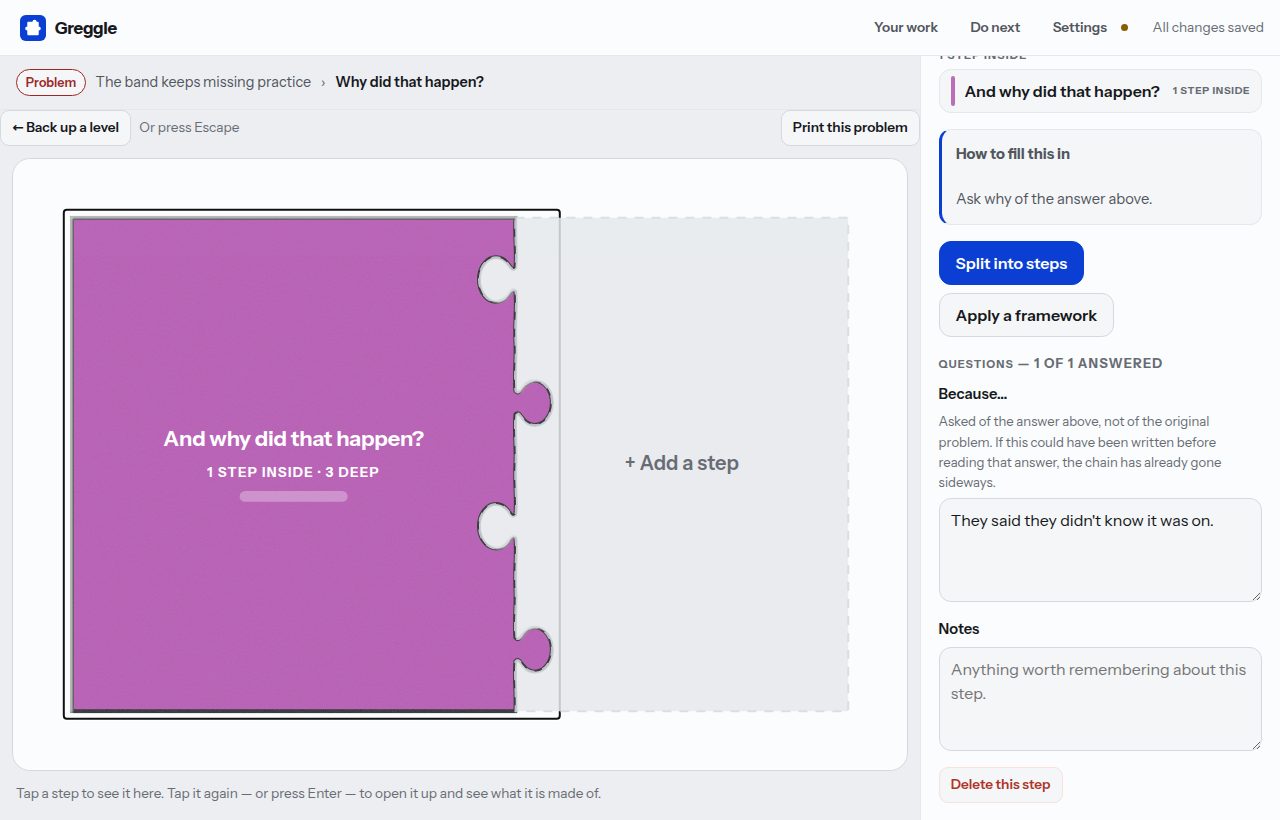
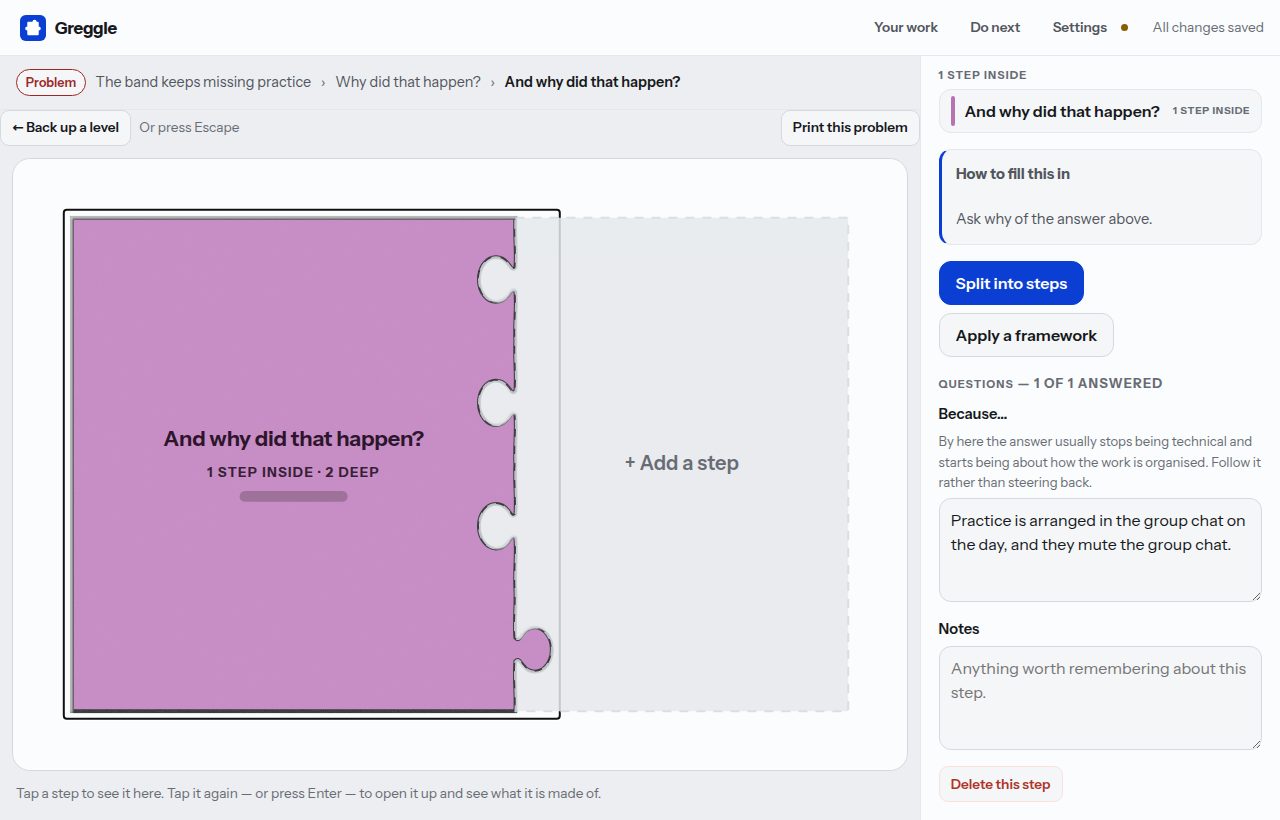
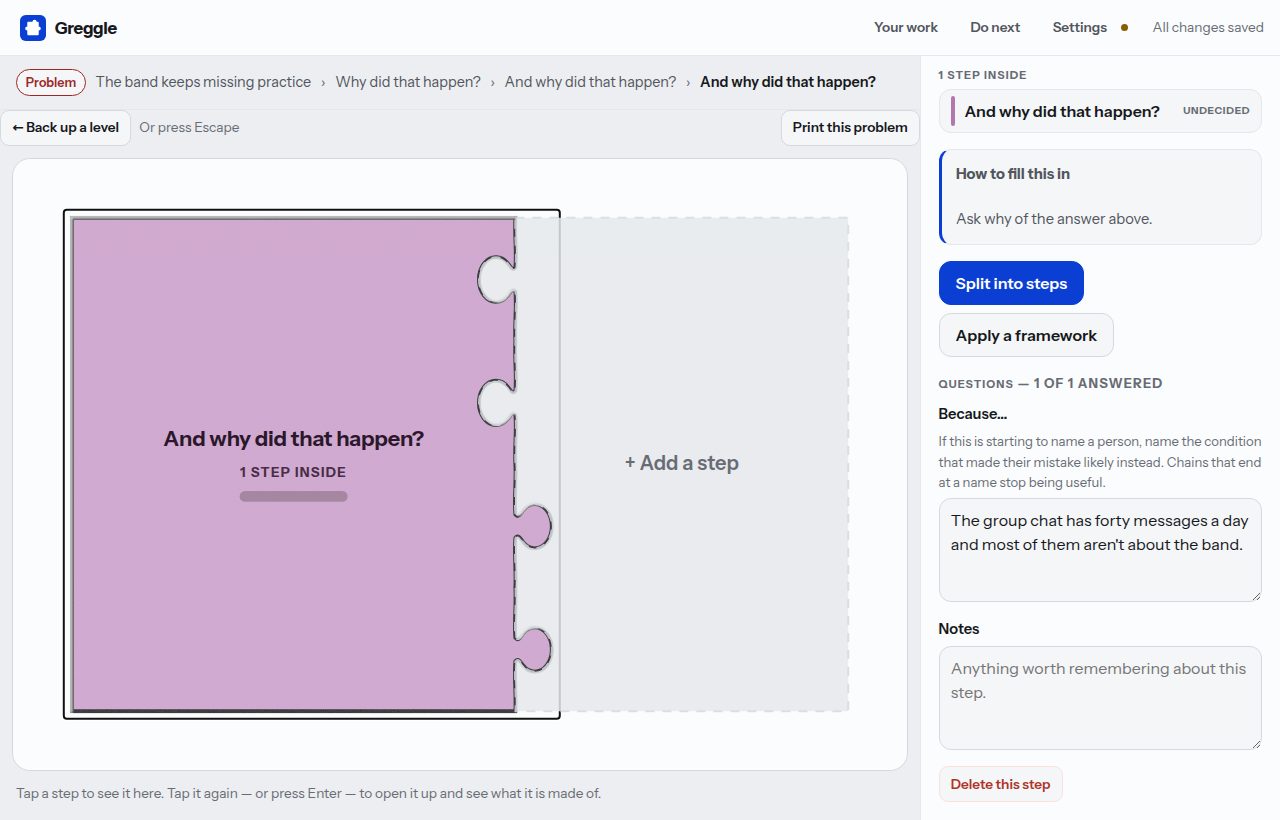
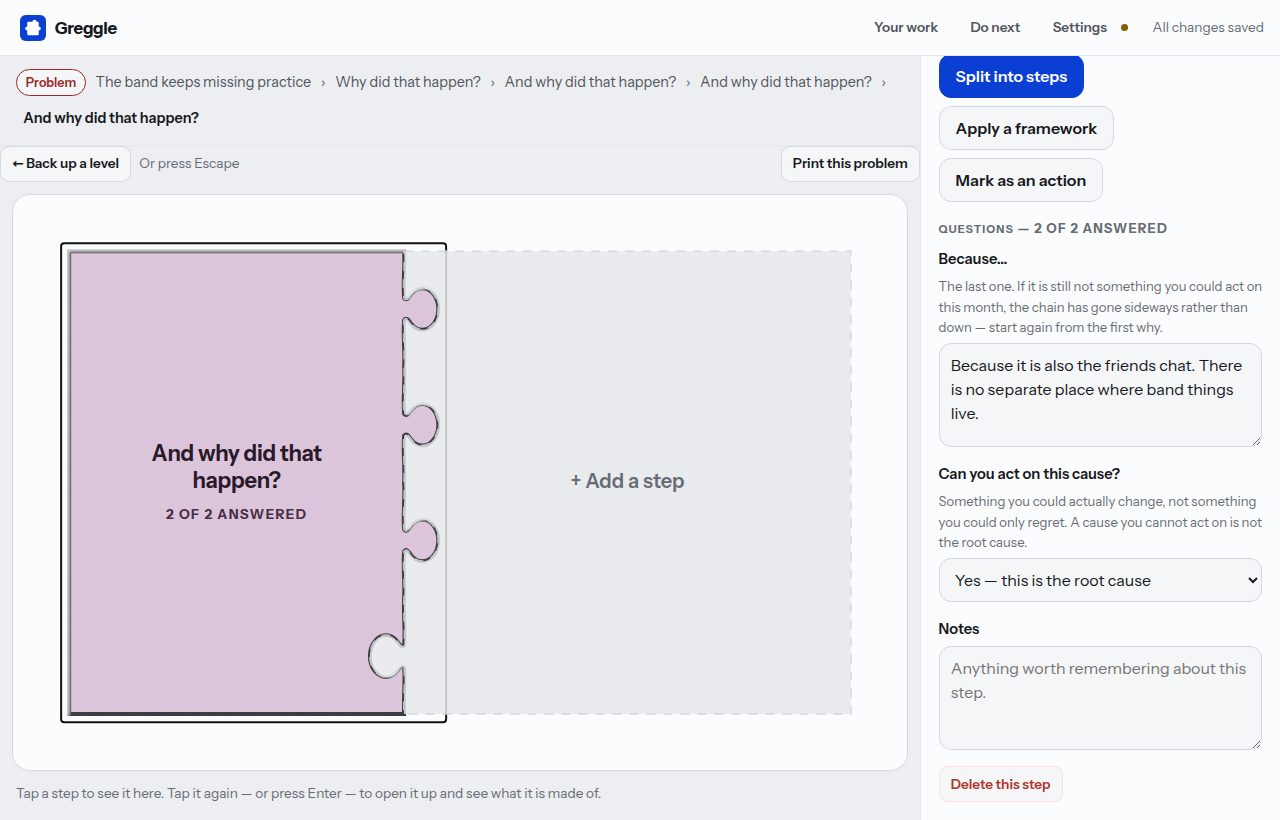
Nothing is added until you have looked at it. Open any step and it becomes a board of its own. Steps that cannot sensibly be cut smaller get marked as actions, and every action collects in one flat list.
What the check looks for
One button reads the whole branch back. On this method it reports, among other things:
- The first why just says the problem again. Restating what went wrong is not a cause of it.
- A why gives back the answer above it, which means it was asked of the original problem rather than of the answer it follows.
- Five whys in, with nothing you can act on. Either the chain went sideways or it has further to go.
A worked example
Notice where it would have been easy to stop. "Two people didn’t turn up" is true and fixes nothing. "They mute the chat" is true and turns into a row. The strainer is the separate chat.
Where it falls down
It assumes one chain of causes. Real problems often have several, and 5 Whys will find whichever chain you happened to start down, then declare it the cause. It is also very easy to reason your way to the cause you already believed in, because each why is answered by the same person who holds the belief. Two people doing it separately and comparing chains is the cheap fix for both.
The technique has been criticised seriously in healthcare, where it was widely adopted for investigating incidents. Alan Card’s 2017 paper argued that it oversimplifies, invites blame, and stops at whatever the investigator finds satisfying. Those are fair. They are also arguments for running it honestly rather than for not running it.
Pairs well with
- Cause and Effect. Go wide first when the problem has many possible causes, then take the two or three most likely into 5 Whys.
- Theory of Constraints. When the fifth why is "because there is never enough time", the constraint is the real problem.
- Pre-mortem. Once you have the fix, imagine it failed and ask why. It is 5 Whys pointed forwards.
Further reading
- Taiichi Ohno, Toyota Production System: Beyond Large-Scale Production. Written in 1978, published in English in 1988. The fuse example is in chapter one.
- Alan J. Card, "The problem with '5 whys'", BMJ Quality and Safety, 2017. The honest critique.
Start with the thing that keeps going wrong.
This opens the app with the kind already chosen. Give the thing a name, press Start, and 5 Whys is proposed on the new board for you to look over before anything is added. Free, no account, works offline.
Open Greggle with 5 Whys