Greggle · Ways of thinking · First Principles
A way of thinking · best for a Challenge or a DecisionFirst Principles
Find the truths nothing else rests on, then build up from them alone.
Aristotle, fourth century BC
a Challenge, a Decision, a Problem, a Goal
An hour, done properly
A willingness to look stupid
Where it came from
Aristotle opens his Physics by saying that we think we understand a thing when we know its first causes and first principles, the basic truths that don’t rest on anything else. Everything we know about a subject is either one of those, or built on them. The Greek word is arche, a beginning.
Descartes rebuilt the whole of philosophy this way in 1637, doubting everything he could doubt until he found something he couldn’t, and starting again from there. Engineers and physicists have worked this way ever since, mostly without naming it. The method came back into everyday conversation around 2012, when Elon Musk described using it to argue that battery packs didn’t have to cost what they cost. What are batteries made of? Cobalt, nickel, aluminium, carbon, some polymers, a can. What do those cost on the metals exchange? A small fraction of the price of a pack. So the price is a fact about how packs are currently made, not a fact about batteries.
That example has been repeated so often it has become a cliche, which is a shame, because the move underneath it is sound and rare. Greggle calls its version First Principles Analysis, and adds a rebuild step that the bare method leaves out.
Why it works
Almost all reasoning is by analogy. This is like that, so do what worked for that. Analogy is fast, and most of the time it is right, which is why we use it. But it carries every assumption of the thing you compared to, and you never see those assumptions because you never chose them.
Going back to what is actually true strips the inherited assumptions out. Quite often the "impossible" part of a challenge was never a fact about the world at all. It was a fact about how everyone has been doing it, dressed up as a law. Naming where each assumption came from, convention, imitation, precedent, fear or nobody ever asking, is what makes it arguable rather than invisible.
When to reach for it, and when not to
Reach for it when the standard answer doesn’t fit and you can feel it, when everyone agrees something can’t be done and nobody can say why, or when you have tried the obvious things and they haven’t worked. It suits a Challenge, where the outcome isn’t in your control and you need an edge nobody else has looked for, and a Decision where the options on the table all feel like someone else’s.
Don’t use it on things other people have already worked out properly. Reasoning from first principles about how to boil an egg is a way of spending an hour to arrive where a recipe would have taken you in a minute. It is also slow and a bit arrogant, and both are fine as long as you reserve it for where they pay. Greggle suggests it on a Goal, a Challenge, a Problem and a Decision.
How to run it
With a pen, on one sheet of paper.
- Describe the situation with enough detail to tell your actual constraints from your assumptions. Say what you know is true and what you believe is true.
- Surface the assumptions. One sentence each. For each, say where it comes from: convention, imitation, precedent, fear, or an unexamined default. Then judge how much weight it carries: if it were false, would the problem change shape?
- Strip them away. What remains that is true regardless? Test each candidate three ways: still true if everyone else doing this vanished tomorrow; still true if you had never tried anything before; sayable without "that’s how it’s done". Aim for three to seven that pass all three.
- Rebuild from those alone, three ways, as if no prior approach existed. One optimised for speed, one for the biggest long-term result, one for simplicity. For each, write the chain from principle to action.
- Find the high-leverage move: the one action first principles makes visible that conventional thinking hides. Say why it was hidden, and name the first concrete step.
- If no single move dominates, write down the runner-up and the trade-off, and choose anyway.
There is a one-page card with these steps and a blank grid to fill in, made to print on A4. Or the PDF.
On a Greggle board
Pick First Principles on a Challenge or Decision board and Greggle proposes four phases: surface the assumptions, establish the principles, rebuild three ways, and the high-leverage move. The assumptions and principles are yours to write.
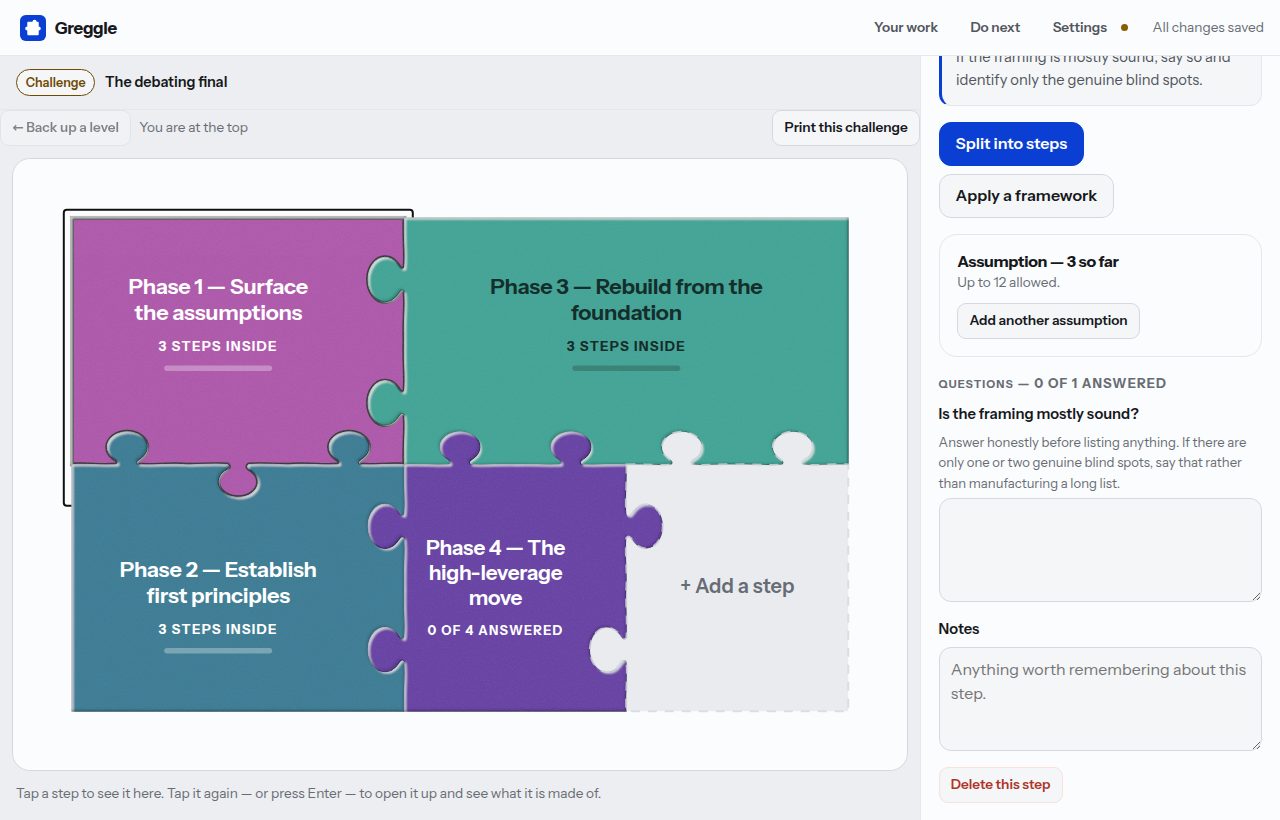
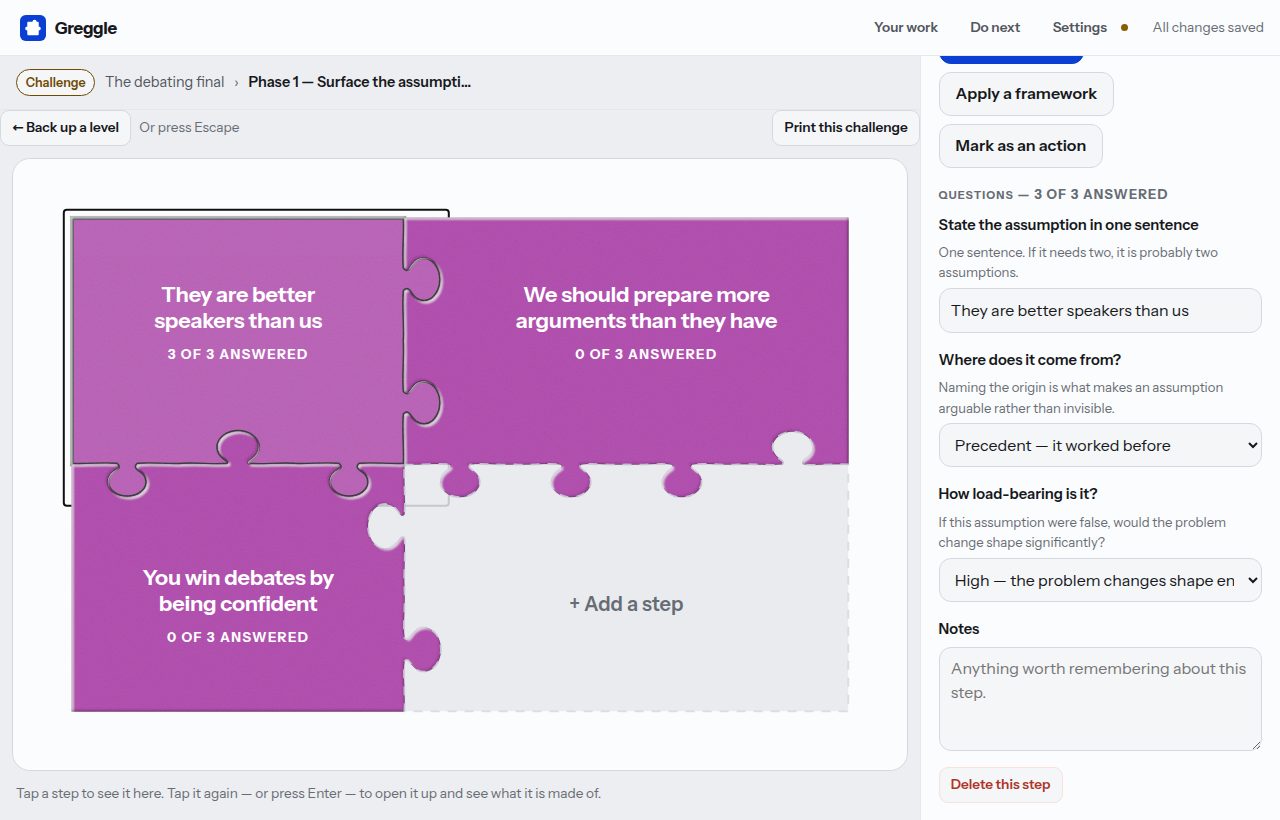
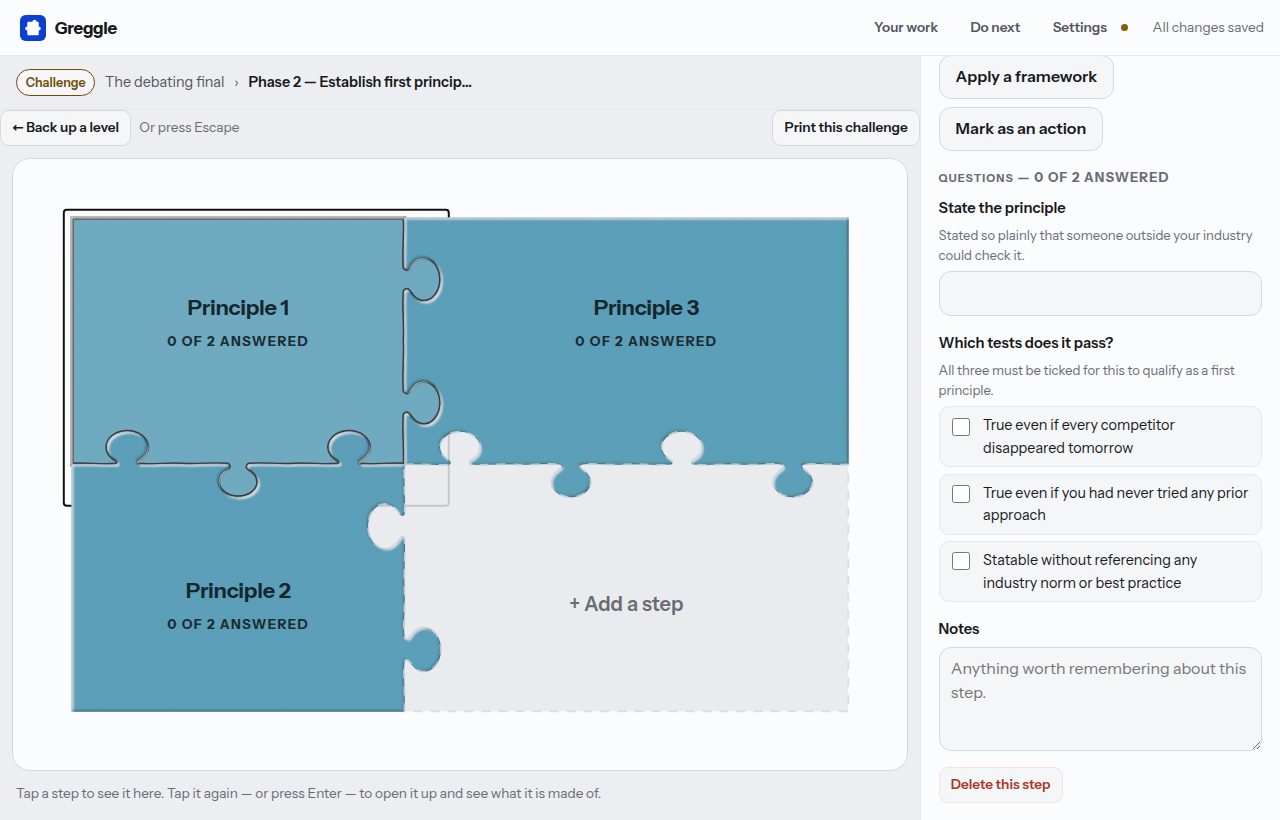
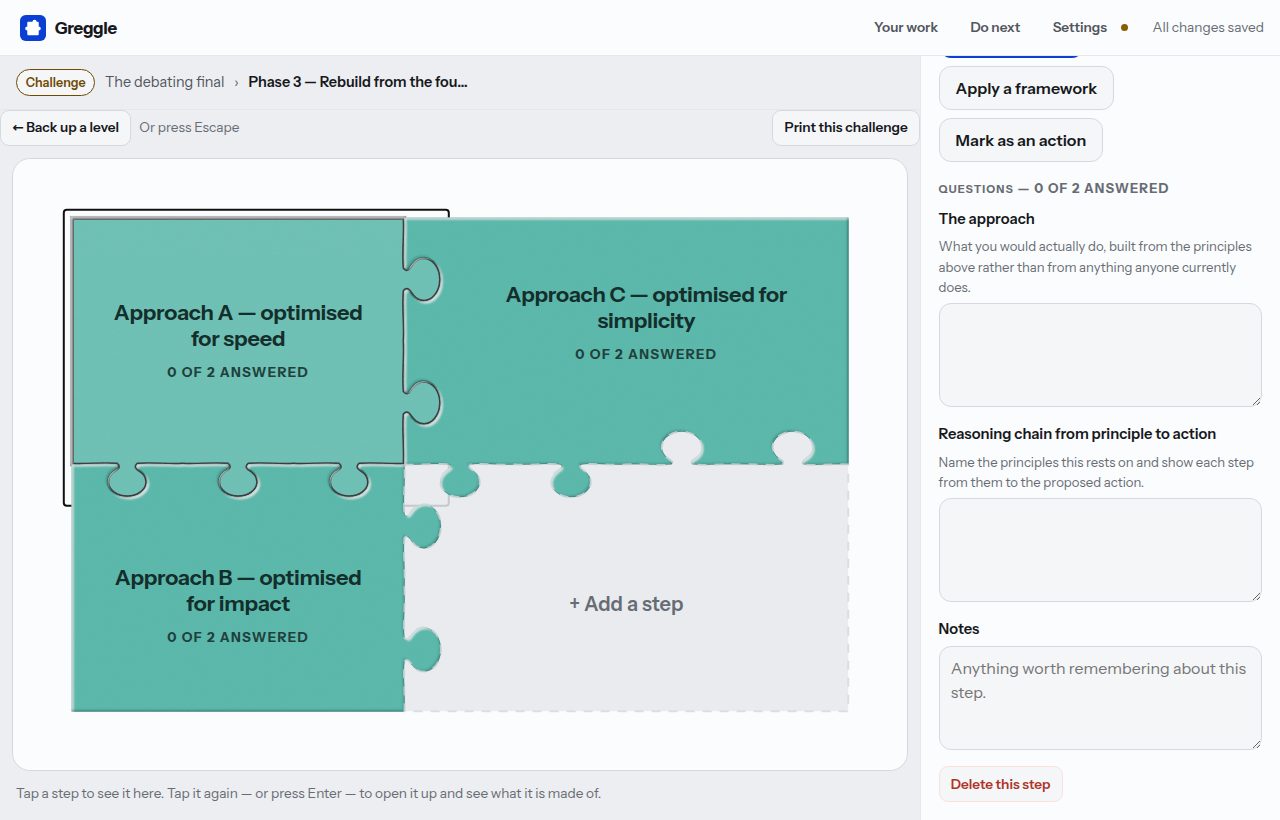
Nothing is added until you have looked at it. Open any step and it becomes a board of its own. Steps that cannot sensibly be cut smaller get marked as actions, and every action collects in one flat list.
What the check looks for
One button reads the whole branch back. On this method it reports, among other things:
- None of the assumptions is holding the problem up. The load-bearing one is usually the one that felt too obvious to write.
- All the assumptions come from the same place, which usually means only one kind was looked for.
- Not one principle survives its competitors vanishing. A statement that stops being true when the others do is a description of them, not a principle.
- An approach names no principles it rests on, which makes it an ordinary idea that happens to sit below phase 2.
A worked example
The challenge. Win the final against the school that has won it four years running. Known true: there are two speakers each, four minutes each, and three judges. Believed: they are better than us.
The plan looks odd, because it involves preparing fewer arguments for a debating final. That oddness is what first principles buys you. Everyone else is preparing more.
Where it falls down
It is slow, and it is easy to mistake a strongly held belief for a first principle. That is what the three tests are for, and they have to be applied honestly. If everything you wrote passes all three, you weren’t testing.
The other trap is contempt for the people who did it the old way. Sometimes the old way is old because it works and the reasons have been forgotten. First principles should make you check the old way, not sneer at it. If your rebuilt plan is wildly different from what everyone else does, treat that as a reason to look harder, then proceed if it holds.
Pairs well with
- Options and Criteria. Greggle calls it the missing half of this method: first principles gives you three approaches and nothing for choosing between them. That is where they get compared.
- Issue Tree. Once the principles are clear, the tree is how you turn them into parts you can work on.
- Strategic Challenge Map. When there are many challenges and you need to know which one to attack, map them first, then go to first principles on the crux.
Further reading
- Aristotle, Physics, book one, chapter one; Metaphysics, book one. Any translation. The opening lines of the Physics are the whole idea.
- Rene Descartes, Discourse on the Method, 1637. Short, and still readable.
Find out what is actually true. Build from only that.
This opens the app with the kind already chosen. Give the thing a name, press Start, and First Principles is proposed on the new board for you to look over before anything is added. Free, no account, works offline.
Open Greggle with First Principles