Greggle · Ways of thinking · Strategic Challenge Map
A way of thinking · best for a Challenge or a ProjectStrategic Challenge Map
Categorise the challenges, evidence each one with a date, judge what you can actually move, then say what would count as proof.
Greggle’s own synthesis
a Challenge, a Project
A day, done properly
Sources you can cite, with dates
Where it came from
This one was not taken from a textbook. It was built for a particular situation: proposing a change into a large organisation, where the reader is a sceptic who has heard "this fixes everything" before and stopped believing it the second time. The method borrows the habits that survive that reader. Evidence with a date, because an undated citation ages silently and is worth nothing in a year. Challenges sorted into four categories, because a technical fix can’t solve an organisational problem and mixing the categories hides that. And an honest verdict on each challenge: does what you are proposing remove it, reduce it, or not touch it?
"Does not touch it" is the answer that gives the method its credibility. A map on which everything is improved reads as a pitch. A map that says plainly what it leaves alone is believed on the things it claims.
The four categories are technological, regulatory, competitive and commercial, and organisational, which are the four ways organisations fail. The last step, naming the proof a sceptic would demand before they ask for it, is what separates a proposal from a pitch.
Why it works
Listing the challenges is easy and useless. Categorising them, attaching dated evidence to each, and then judging honestly which ones your proposal moves turns a worry list into an argument somebody can check. Half the challenges usually evaporate at the evidence step, which is the point of having one.
The ranking is by urgency and hard deadlines, not by how interesting a challenge is, and the proof metrics are volunteered rather than extracted. Stating the standard you will be judged against, before you are asked for it, is the single most persuasive thing a proposal can do.
When to reach for it, and when not to
Reach for it when you are proposing something into an organisation, a school, a club, a council, a company, and the people who decide are sceptical, busy and have been burned before. A Challenge whose outcome depends on being believed, or a Project that has to be approved before it can start.
It is far too heavy for a personal decision, and it is the wrong tool when the challenge is inside you rather than in the organisation. Of the fourteen, it is the one most obviously built for work rather than for a kitchen table, and the worked example below scales it down deliberately. Greggle suggests it first on a Challenge, and on a Project.
How to run it
With a pen, on one sheet of paper.
- Write the strategic context in a paragraph: what the organisation has to keep running, what it is trying to change, and the pressure it is under while doing both. Then name what you must not position against: the people, systems and decisions that are off the table.
- Work four categories in turn: technological, regulatory, competitive and commercial, organisational. Under each, list the challenges, at least two, stated as things that are the case rather than things you dislike.
- For every challenge, cite the evidence that it is real and the date that evidence carries. A challenge with no citation is an opinion.
- For every challenge, say whether your proposal removes it, reduces it, or does not touch it, and justify the verdict mechanically: what changes that makes this stop being true. Then name the proof a sceptical expert would insist on.
- Rank the challenges by urgency, driven by deadlines and consequences. Everything critical means nothing is. For each, judge how well a lightweight intervention fits versus changing something at the core.
- Define the proof: the metrics that would satisfy the sceptic, each stated so two people would collect the same number, sorted by the kind of doubt it answers, with the artefact you would put in front of them.
There is a one-page card with these steps and a blank grid to fill in, made to print on A4. Or the PDF.
On a Greggle board
Pick Strategic Challenge Map on a Challenge board and Greggle proposes the context, four category steps with two challenges each to start, a ranking with three to start, and the definition of proof.
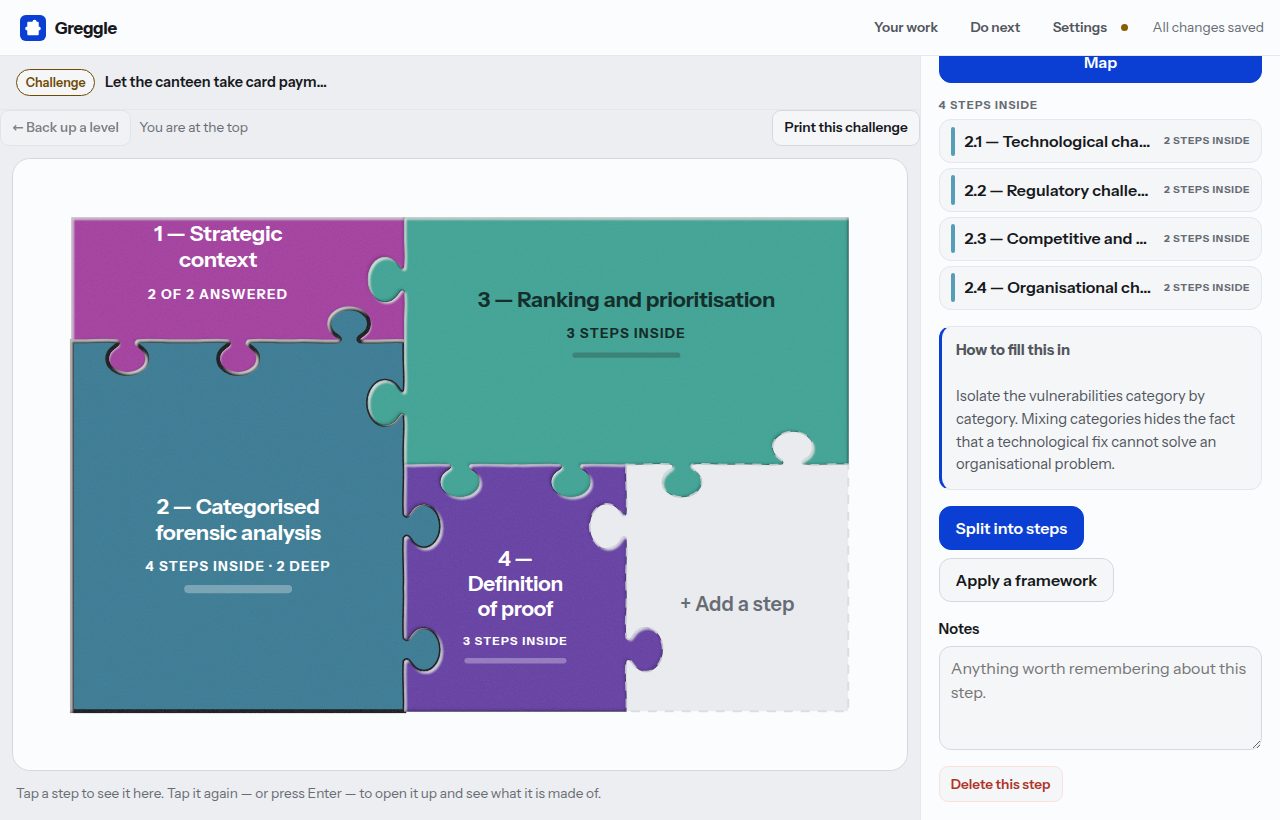
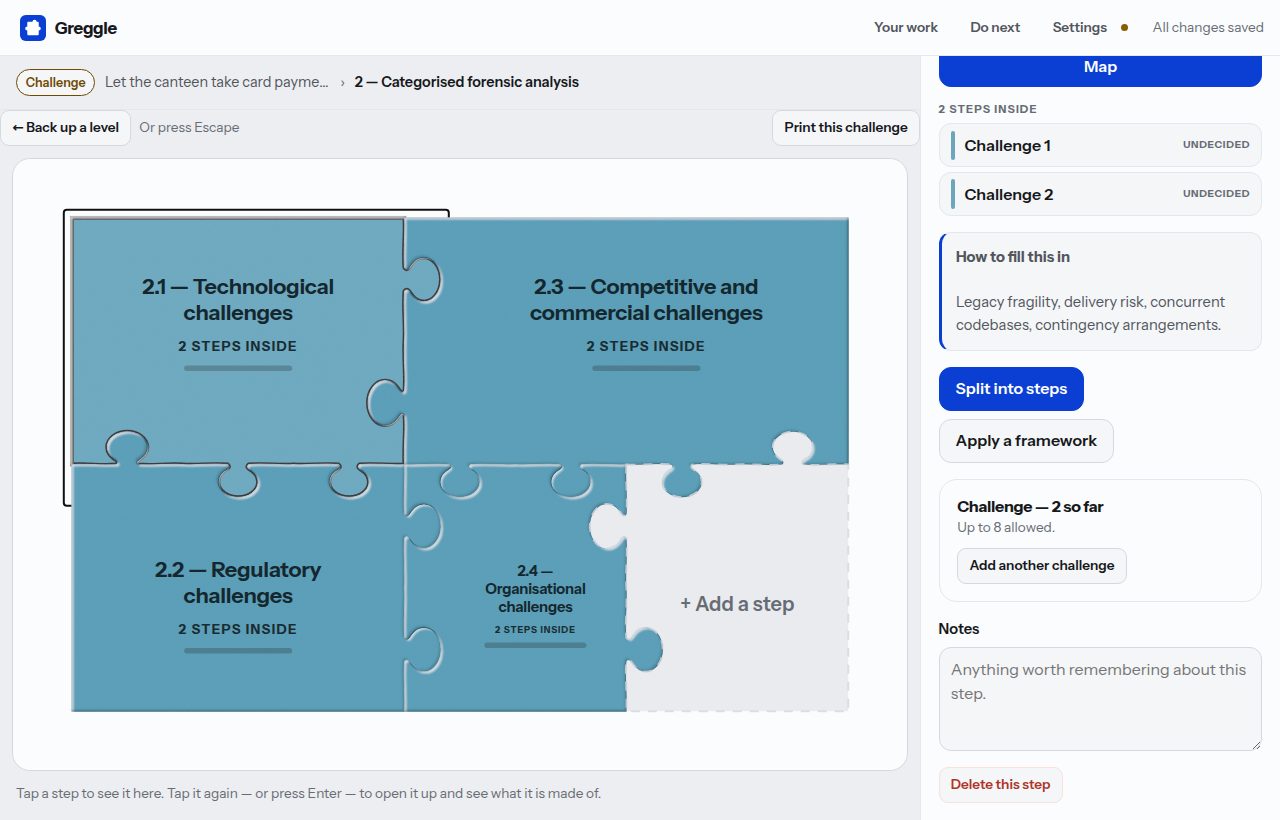
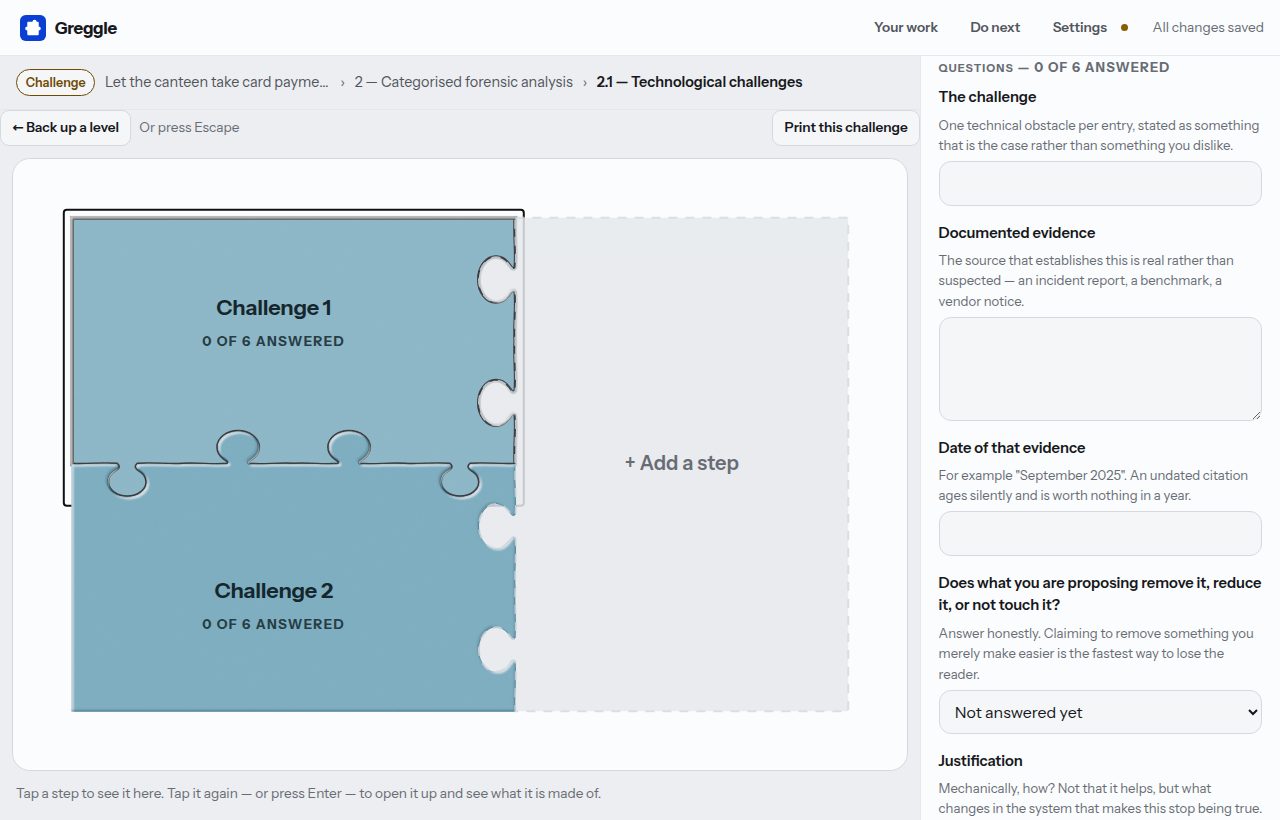
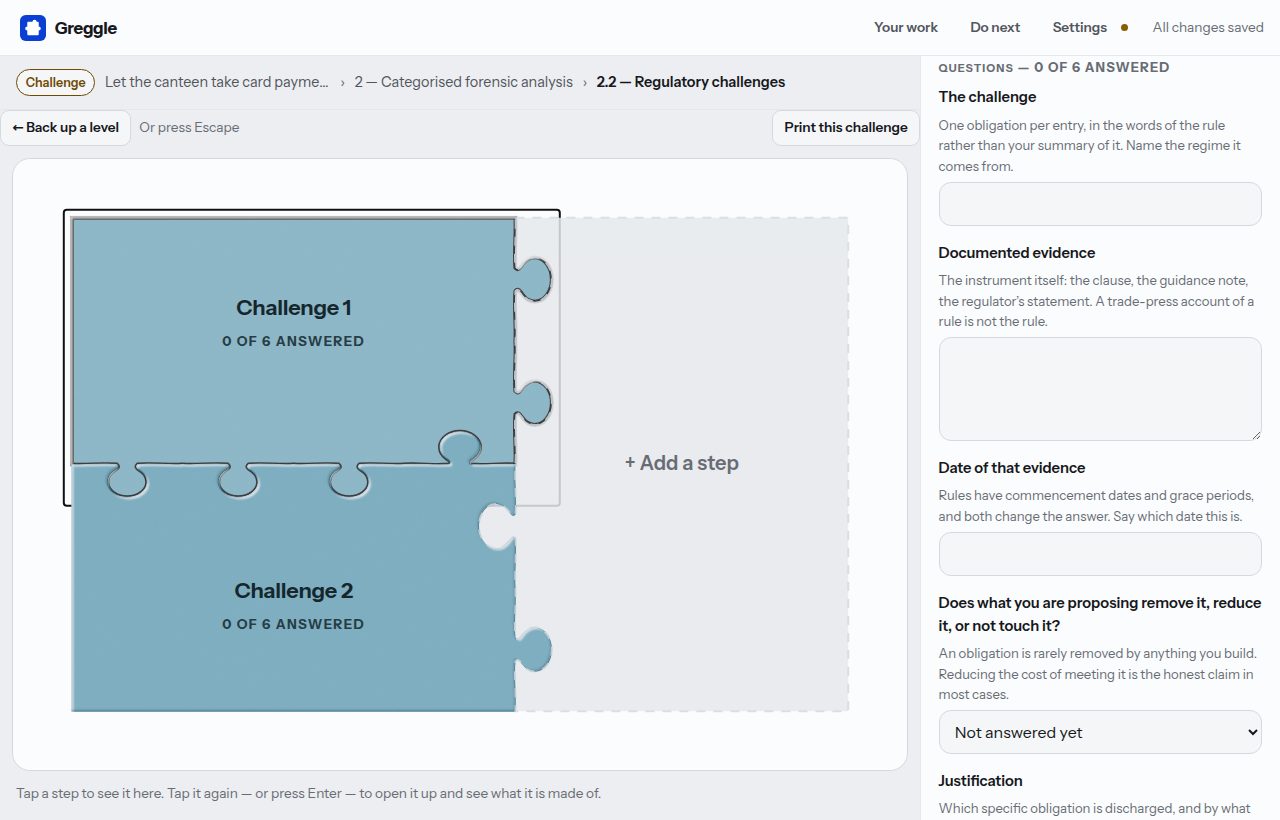
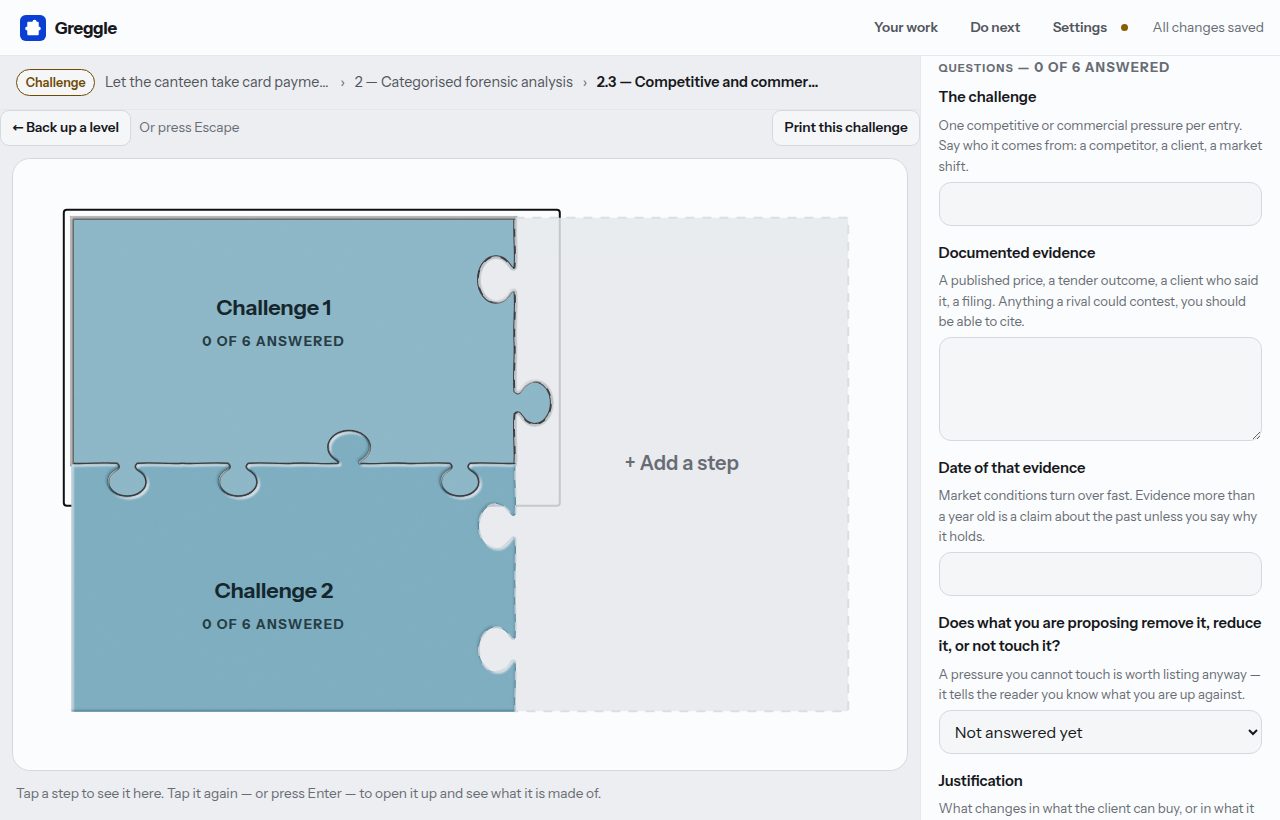
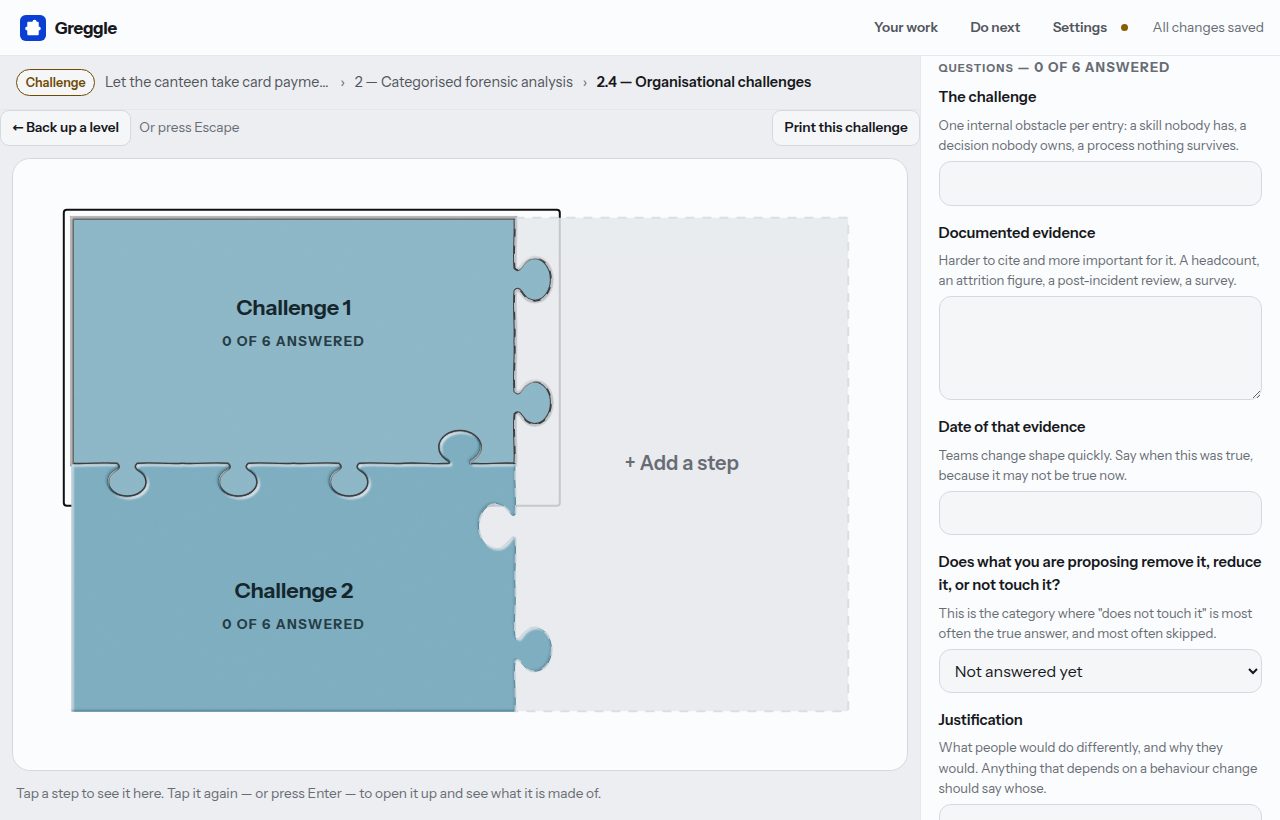
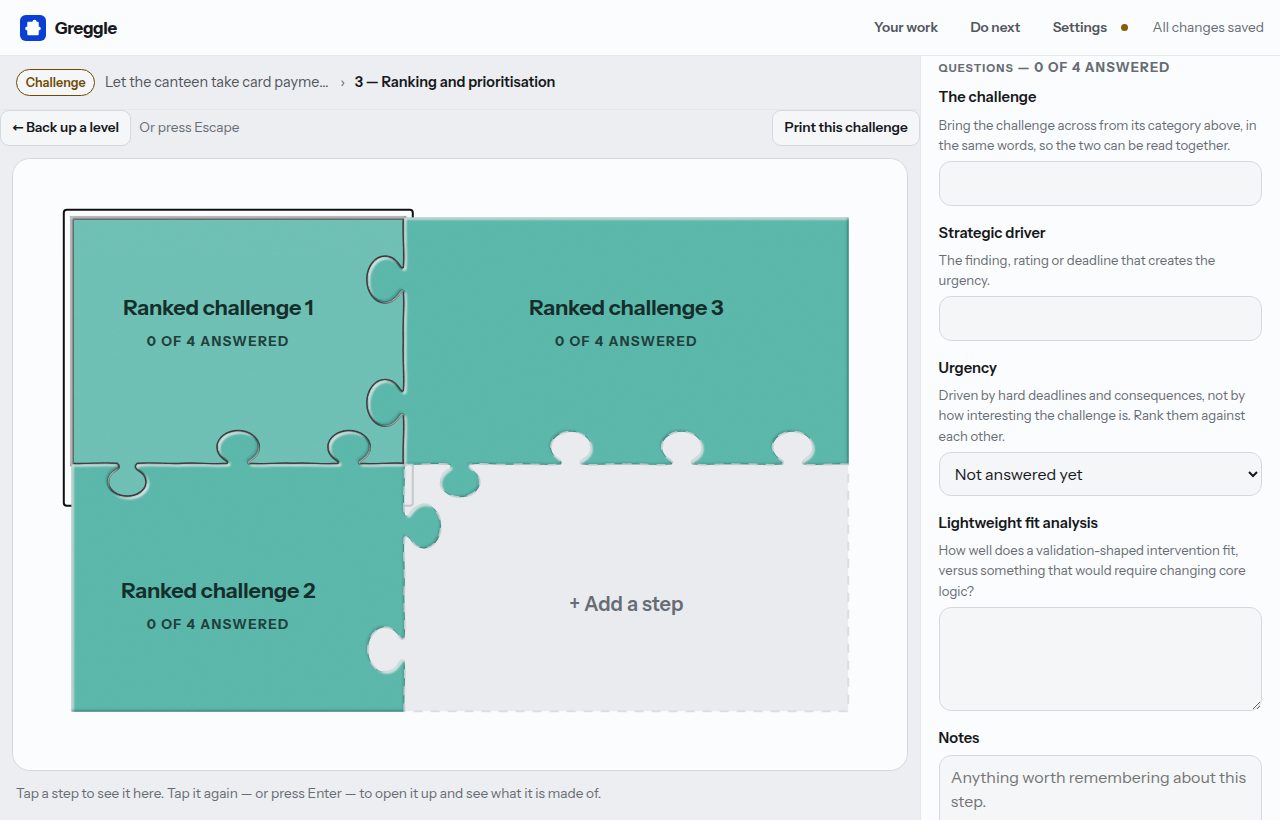
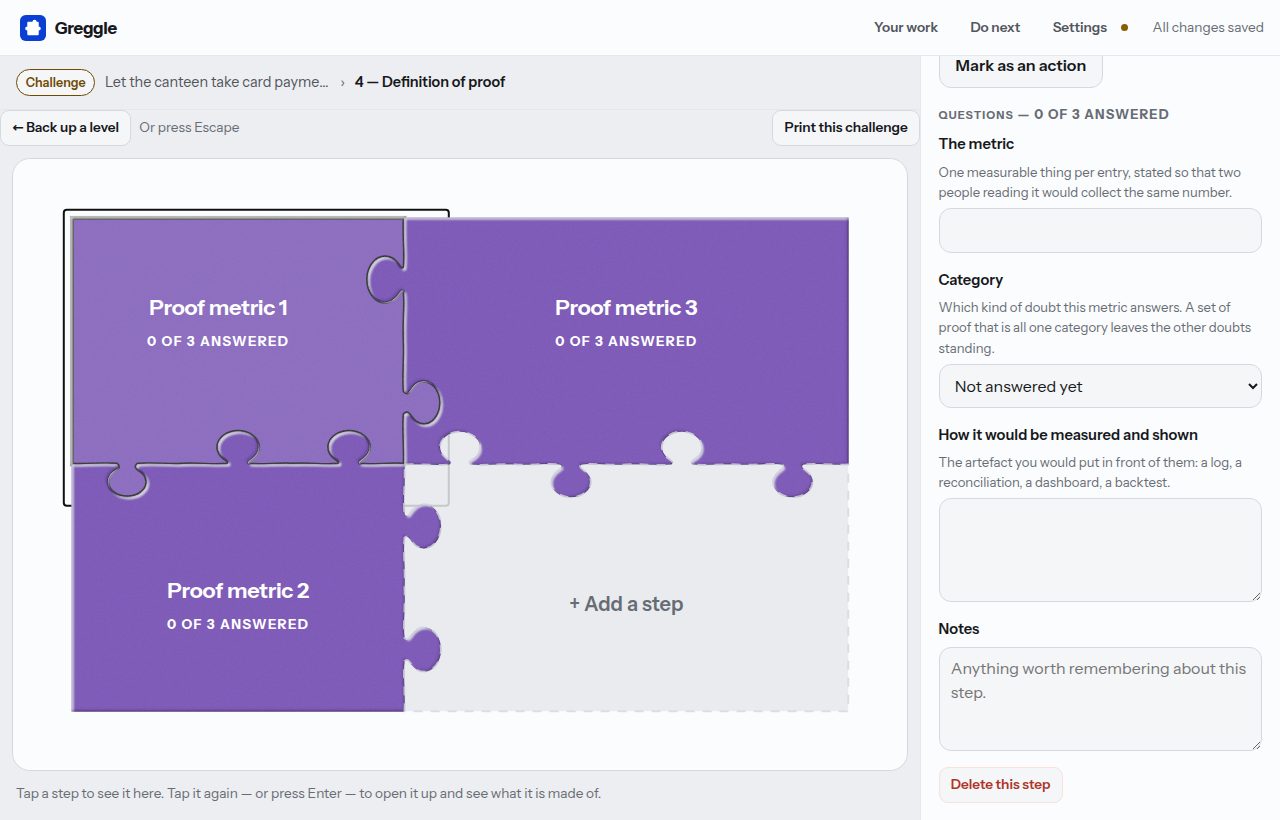
Nothing is added until you have looked at it. Open any step and it becomes a board of its own. Steps that cannot sensibly be cut smaller get marked as actions, and every action collects in one flat list.
What the check looks for
One button reads the whole branch back. On this method it reports, among other things:
- Challenges have been written and not one says when its evidence was true.
- Every challenge in a category is one you improve. A section without a "does not touch it" reads as a pitch rather than an analysis.
- A challenge is claimed as removed with no proof named. The strongest claim is the one that will be tested hardest.
- All the ranked challenges carry the same urgency, so the ranking cannot say what to do first.
A worked example
The organisational challenge is the one the proposal honestly doesn’t touch, and saying so is what makes the bursar believe the other three. A version that claimed to solve training would have lost her at that line.
Where it falls down
Without the evidence step it becomes a list of fears. With the evidence step but without dates, it becomes a list of things that were true once. The dates are the discipline, and they are the part people skip because finding them is tedious.
It is also heavy. Run in full on a small decision, it produces a document nobody asked for. The scaled-down version in the example above kept all four categories and all four verdicts and took an afternoon; the point is the honesty of the verdicts, not the length of the map.
Pairs well with
- Stakeholder and Influence Map. The sceptic you are writing for has a name. Find out what they actually want before you decide which proof to volunteer.
- Answer First. Once the map exists, the proposal itself should open with the answer and hang the categories beneath it.
- First Principles. When the challenges all rest on how things have always been done here, strip the assumptions before you evidence them.
Further reading
- This method has no single source. The definition that runs the app is a data file, and it is the reference.
- Richard Rumelt, Good Strategy Bad Strategy, 2011. Not a source for this method, but the best book on diagnosing the challenge before proposing anything.
Evidence every challenge. Then say which ones you don’t touch.
This opens the app with the kind already chosen. Give the thing a name, press Start, and Strategic Challenge Map is proposed on the new board for you to look over before anything is added. Free, no account, works offline.
Open Greggle with Strategic Challenge Map